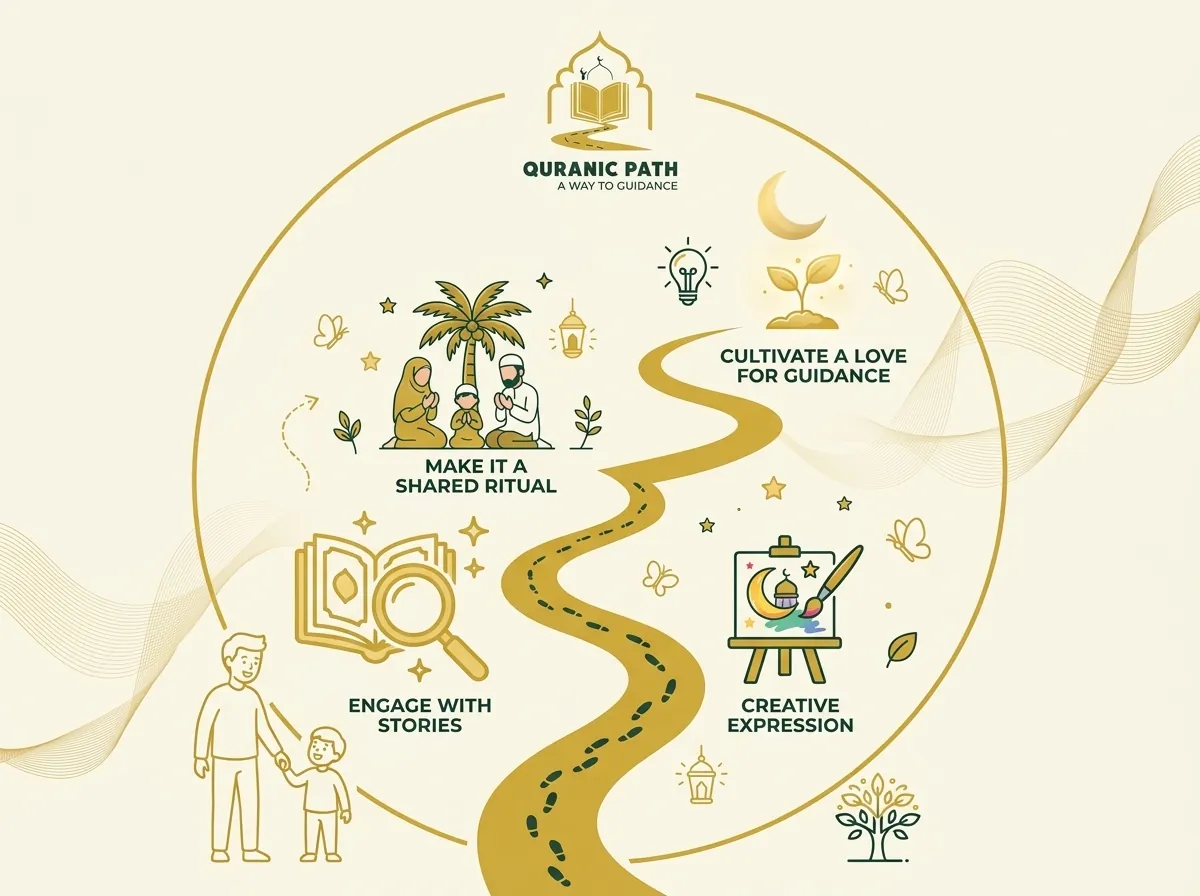
It is a familiar scene in many Muslim homes. The Quran is on the table, the lesson starts in ten minutes, and your child has just said the sentence every parent quietly dreads: “Do I have to?”
In that moment two feelings tend to arrive together. There is frustration, because this matters to you deeply. And there is worry, because you cannot help wondering whether you are doing something wrong. Perhaps other children in the family seem to take to it effortlessly. Perhaps you remember your own childhood Quran lessons, and not every one of those memories is warm.
Here is the reframe this whole guide is built on: the goal is not a finished lesson. The goal is a child who, years from now, opens the Quran because they want to. A lesson can be completed under pressure. A relationship cannot. This article is about how to build the second thing — patiently, practically, and without turning the Quran into a battleground.
Quick Answer: To help a child enjoy learning the Quran, keep lessons short and age-appropriate, make progress visible and celebrated, give the child real choices inside a steady routine, and treat mistakes as normal rather than as failures. When a child resists, listen first and look for the real cause — timing, lesson length, difficulty or teaching style — instead of pushing harder. A child who feels safe and successful with the Quran is far more likely to keep returning to it for life.
The Real Goal Isn’t a Finished Lesson — It’s a Relationship
There are two very different ways to measure a child’s Quran learning. The first counts what is completed: pages read, surahs memorised, levels passed. The second asks a quieter question: how does my child feel when the Quran is opened?
Both matter, but they are not the same thing, and it is the second that decides what happens in the long run. A child can finish an impressive amount of Quran while quietly associating it with tension, fear of mistakes, or the feeling of being watched and corrected. When the teacher and the parent eventually step back — in the teenage years, or at university, or when life becomes busy — that kind of learning can fade very quickly, because nothing warm was holding it in place.
A child who has come to associate the Quran with safety, small daily victories, stories they enjoyed, and the feeling of making their parents and their teacher proud tends to keep coming back to it, even when nobody is asking them to.
The Prophet Muhammad ﷺ said: “Kindness is not found in anything except that it beautifies it, and it is not withdrawn from anything except that it leaves it marred.” (Sahih Muslim). If we want the Quran to feel beautiful to a child, the way it is taught has to be beautiful too — gentle, patient and encouraging.
This is the philosophy we teach by at Quranic Path: a child who looks forward to their class is a better sign than a completed page. The aim of every lesson is not only to move forward in the material, but to help the child develop a positive, lasting relationship with the Quran. Everything in the rest of this guide follows from that.
Why Children Start to Dislike Quran Lessons
Before fixing resistance, it helps to understand where it usually comes from. In almost every case, a child’s dislike of Quran lessons is a reaction to something about the experience, not a rejection of the Quran itself. The most common causes are worth going through honestly:
- Pressure and fear of getting it wrong: when every mistake is met with a sigh, a raised voice or a sharp correction, children learn that the Quran is where they get things wrong in front of people they want to please.
- Lessons that are too long for their age: a young child asked to sit and drill for far longer than they can focus will start to associate the Quran with boredom and restlessness.
- Poor timing: a lesson squeezed in when a child is exhausted after school, hungry, or has just been pulled away from play or a screen starts with resistance built in.
- Material that is too hard, too soon: being asked to read before the letters are secure means repeated failure. Children rarely enjoy things they keep getting wrong.
- Comparison: “Look how well your cousin reads” is meant as motivation and lands as criticism.
- Linking the Quran with punishment or anger: “Go and read Quran” as a consequence, or tense revision sessions that end in raised voices, quietly teach that the Quran is something unpleasant.
- A teaching style that doesn’t match the child: some children thrive on repetition; many need stories, movement, variety or praise to stay engaged.
- No sense of meaning: reciting words with no idea what they are about can feel empty, especially to a curious child.
Notice what is missing from that list: laziness, defiance, or a “bad attitude.” Almost every item on it is about the environment around the child, which is very good news — because the environment is something a parent can change.
What to Do When Your Child Doesn’t Want to Attend Quran Lessons
When resistance shows up, the instinct is to push harder or to give up. There is a third option that works far better: treat the resistance as information.
Ask Away From Lesson Time
Choose a calm moment — a car journey, a walk, bedtime — and ask open questions: “What is the hardest part of Quran class?” “What is your favourite part?” Children often say far more when they don’t feel they are being cross-examined about a lesson.
Match What You Hear to the List
Is it the timing, the length, the difficulty, the pressure, or the teaching style? If possible, sit in on a lesson and talk to the teacher. A good teacher wants to know how the child is feeling and will welcome the conversation.
Adjust One Variable at a Time
Move the lesson to a better time, shorten it, slow the pace, or change the format. Changing one thing lets you see what actually helps, rather than overhauling everything at once and never knowing which change worked.
What tends to make it worse: threats, comparisons with other children, removing things they enjoy until they “finish” Quran, calling them lazy, and using the Quran itself as the consequence for misbehaviour. Each of these can turn a temporary phase into a lasting negative association.
A note on taking a pause: if a child is genuinely distressed, a short, deliberate pause in formal lessons — while keeping warm, informal contact with the Quran through listening, stories and short surahs at bedtime — can sometimes serve the long-term relationship better than pushing through. There is no universal rule, and you know your child best. The key is that it is a decision you make on purpose, with a plan to return gently, rather than avoidance quietly winning by default.
Encouraging Without Forcing: Structure Isn’t the Same as Pressure
Many parents worry that encouraging without forcing means having no structure at all. It doesn’t. Children generally feel secure when some things are non-negotiable — it is simply that the Quran routine happens, the way brushing teeth happens. What creates resistance is not the routine itself but the tension surrounding it.
The approach that tends to work is steady structure with real choice inside it. The fact of Quran time is fixed. Many of the details can belong to the child:
- Which activity comes first: a game, a story, or the recitation?
- Where they sit: the sofa, a special cushion, the garden on a warm day.
- Who they recite to: a parent, a grandparent on a video call, a younger sibling, a favourite soft toy.
- How progress is shown: a chart, a sticker book, a jar of stars — whatever your child finds motivating.
Alongside choice, two habits make a large difference. First, praise effort and specifics rather than only perfection: “I heard how clearly you said that letter” builds far more than “good job.” Second, end every session on a success, even if that means finishing with something your child already knows well. A child who leaves each lesson feeling capable arrives at the next one more willing.
Structure gives security; pressure creates resistance. A predictable routine, warm attention, and real choices tell a child “this is safe, and you have a say.” Threats and comparisons tell them “this is where you might fail.” The first builds a relationship; the second only produces compliance, and often not for long.
What Is the Best Age to Start Teaching a Child the Quran?
There is no single correct age, and it is worth saying so plainly, because many parents carry unnecessary guilt about having “started too late.” The commonly recommended window for beginning formal Arabic letter learning is roughly 4 to 6 years old, a point our guide to teaching a child to read Quran covers in more depth. Young children pick up new sounds easily, and starting gently at this stage gives plenty of time to build confidence without any rush.
Before that, informal exposure is valuable and requires no lessons at all: listening to recitation at home, saying Bismillah together before meals, and a short surah at bedtime. These build familiarity and warmth long before any formal learning begins.
If your child is older — 7, 10, or even a teenager — it is not too late. Older children can often move through the early stages quite quickly because they can already read in another language and understand explanations. What matters more than the exact age is readiness, and a few signs are worth looking for:
- They can sit and focus with an adult for around ten minutes.
- They show interest in letters, books or sounds.
- They can follow simple, step-by-step instructions.
- They are comfortable spending a short time with a teacher without a parent right beside them.
If some of these aren’t there yet, waiting a few months and continuing informal exposure is often better than starting formal lessons too early and creating early frustration.
How Long Should a Child’s Quran Lesson Be?
Shorter and happier beats longer and dreaded. As a general guide, not a strict rule:
| Age | Typical Focused Lesson | Home Practice | What It Usually Looks Like |
|---|---|---|---|
| 4–6 years | About 15–20 minutes | 10–15 minutes, daily | Letters through games, songs and stories; lots of short changes of activity |
| 7–9 years | About 20–30 minutes | 15–20 minutes, daily | Joining letters, reading short words and surahs, simple Tajweed habits |
| 10 years and over | About 30 minutes | 15–20 minutes, daily | More independent reading, Tajweed detail, and memorisation goals if wanted |
Our standard one-to-one classes at Quranic Path are 30 minutes. For a younger child, what matters is not only the length but how that time is used: a class that moves between short, varied activities feels very different from one long drill. If you are considering any teacher, a trial class is the best way to see how a child’s time is actually spent.
At home, resist the urge to make up for a difficult week with a marathon session. A child who has a hard day and then faces a very long revision often leaves feeling worse than when they started.
Making It Enjoyable: What Actually Works
Enjoyment is not a distraction from serious learning; for children it is the engine that makes serious learning possible. Several approaches consistently help:
Pair Recitation With Stories
Stories of the Prophets give the words a world to live in. A child who knows why a surah matters listens to it very differently. Our children’s teachers regularly weave stories of the Prophets into lessons alongside recitation.
Use Games and Variety
Letter-matching, listening games, “be the teacher” role reversals and short movement breaks keep young minds engaged. Our 25 Quran activities for kids has plenty of ideas parents can try at home, none of which require Arabic.
Make Achievement Visible
A simple chart of letters mastered or surahs learned turns invisible progress into something a child can see and feel proud of. Celebrate milestones — the first full surah, finishing Noorani Qaida — as a family.
Give Them Someone to Share It With
Reciting for a grandparent, an uncle or a cousin over a video call turns practice into something to be proud of. Children love having an audience that is delighted rather than critical.
Above all of these sits the teacher. A warm, patient teacher who notices small improvements and makes a child feel capable can transform how a child feels about the Quran. It is worth choosing carefully, and it is worth being willing to change teachers if the fit is wrong. Our guide on choosing an online Quran teacher explains what to look for.
Building Consistency Without Pressure
Consistency matters enormously with children, but it should come from routine rather than from nagging. A few principles help:
- Anchor it to something that already happens: straight after an after-school snack, right after dinner, or as part of the bedtime routine. A moment that already exists removes the daily negotiation.
- Favour small and daily over long and occasional: ten to fifteen minutes every day builds far more than one long weekend session.
- Treat a missed day as one missed day: resume the next day without a lecture and without trying to make up the time.
- Sit nearby, even if you don’t read Arabic: five minutes of listening, or asking “teach me what you learned today,” tells your child this matters to you and turns them into the expert.
Families juggling several children, work and activities often find this the hardest part. Our guide to building a Quran routine around a busy family schedule goes into practical ways to fit it around a full household.
Should Children Learn Noorani Qaida Before Reading the Quran?
For most beginners, yes — and it is worth understanding why, because it directly affects how much a child enjoys learning. Noorani Qaida teaches the shape, sound and correct pronunciation of each Arabic letter before letters are joined into words. It is the foundation the rest of Quran reading is built on.
It also protects enjoyment. A child who is asked to read the Quran before the letters are secure hits failure again and again, and children rarely enjoy things they keep failing at. Qaida gives small, achievable wins from the very first lessons — a letter mastered, a word read — and those early successes build the confidence that carries a child through the harder stages.
The manner of teaching matters as much as the content. Qaida taught as dry repetition can feel tedious; taught with games, praise and variety, it can be one of the most enjoyable stages of the whole journey. You can read exactly what it covers in our complete guide to Noorani Qaida, or see how the course is structured on our Noorani Qaida course page. A child who already reads confidently may only need a short assessment rather than the full course.
Are Online Quran Classes Suitable for Children?
For many children, yes — but it deserves an honest answer rather than an automatic one. One-to-one online lessons have real advantages for children: the teacher’s full attention is on your child, the pace and activities can be adapted to how they are responding on the day, there is no travel when they are already tired, and families can often arrange a female teacher for girls.
They work best when a few conditions are met:
- A quiet, comfortable space with minimal distractions.
- A parent nearby, especially for younger children and especially in the first few weeks.
- A teacher who keeps the lesson interactive rather than lecturing at a screen.
- Timing when the child is alert rather than exhausted.
Some children, particularly very young ones or those with very short attention spans, may benefit from starting a little later or from having a parent alongside. And some children simply respond better to in-person learning — online is not automatically better than learning at a mosque or with a local teacher; it is one good option among several. The most reliable test is a trial class: watch how your child looks when it ends. A smile and a willingness to come back tells you far more than any description.
At Quranic Path we teach children from age 4, offer female teachers, and give every family 3 free trial classes to see the fit for themselves. Progress is shared through monthly progress reports and a student portal, so parents can see how their child is doing without having to hover.
See How Your Child Feels in a Real Class
The best way to know whether a teacher and format suit your child is to try it. Quranic Path offers 3 completely free trial classes — no card, no commitment — so you and your child can see the fit before deciding anything.
Book 3 Free Trial Classes Or explore our children’s course options firstGrowing a Lasting Love: The Long Game
Lessons, routines and games are the scaffolding. What lasts is something deeper, and it is built slowly over years. A few things matter most.
Let them see your own relationship with the Quran. Children learn more from what they watch than from what they are told. A parent who opens the Quran for a few minutes each day, even imperfectly, shows that it is part of life rather than a school subject. If you yourself feel distant from it, our guide on reconnecting with the Quran is written for exactly that.
Connect recitation with meaning as they grow. Young children can enjoy simple explanations of what a short surah is about. Older children can begin to ask what a verse teaches and how it applies to their own lives. This is the path we hold in mind at Quranic Path: learn the Quran, understand its guidance, and grow through it. Studies such as Islamic History and Studies and the stories of the Prophets are part of that, not an optional extra.
Stay patient through phases. Almost every child has stretches when interest dips. Reduce the pressure, not the connection: keep the bedtime surah, keep the family stories, keep the door warm. A child who knows the Quran is a safe, welcoming place will find their way back to it far more readily than one who learned to avoid it.
Celebrate belonging, not just achievement. Let your child feel that being someone who loves the Quran is part of who they are and part of your family’s story — not merely something they are graded on.
Frequently Asked Questions
Keep lessons short and age-appropriate, mix recitation with stories of the Prophets and simple games, make progress visible so your child can see how far they have come, and praise effort rather than only perfection. Enjoyment comes from feeling safe, capable and warmly encouraged, not from lessons being easy.
Start by listening rather than insisting. At a calm moment away from lesson time, ask what feels hardest and what they enjoy, then look for the real cause: lessons that are too long, poor timing, material that is too hard, pressure, or a teaching style that does not suit them. Change one thing at a time rather than simply pushing harder.
Keep the routine steady but give your child real choices inside it, such as which activity comes first or who they recite to. Praise specific effort, end every session on a success, avoid comparisons with other children, and never use the Quran as a punishment. Structure gives security; pressure creates resistance.
There is no single correct age. Many families begin formal Arabic letter learning at around 4 to 6 years old, with gentle listening and short surahs before that, but older children can start successfully too and often move through the basics quickly. Readiness and a warm, low-pressure approach matter more than the exact age.
For most 4 to 6 year olds, around 15 to 20 minutes of focused learning works best, rising to roughly 20 to 30 minutes for ages 7 to 9 and around 30 minutes for older children. How the time is used matters as much as the length: short, varied activities keep young children engaged far better than one long drill.
Attach a short daily Quran moment to something that already happens every day, such as after an after-school snack or before bed. Small daily practice beats occasional long sessions, and a missed day should be treated as a single missed day. Sitting nearby and asking your child to teach you what they learned helps even if you do not read Arabic.
For most beginners, yes. Noorani Qaida teaches each Arabic letter's shape, sound and correct pronunciation before letters are joined into words, which prevents the frustration of trying to read beyond their ability. When it is taught gently, it also gives children early, achievable successes that build confidence.
For many children, yes, particularly one-to-one lessons where the teacher can adapt pace and activities. It works best with a quiet space, a parent nearby for younger children, and a teacher who keeps the lesson interactive. Very young children or those with very short attention spans may need a later start or a parent alongside. A trial class is the best test.
Focus on the relationship rather than the finished lesson: keep early experiences warm and successful, model your own connection with the Quran, share the meaning and stories behind what your child recites as they grow, and stay patient through phases when interest dips. Children who associate the Quran with safety, pride and belonging are the most likely to keep returning to it.
Build the Relationship, and the Lessons Follow
If your child is resisting Quran lessons right now, it does not mean the door has closed. It usually means something about the experience needs adjusting — the timing, the length, the pace, the pressure, or the fit with the teacher. Every one of those can change.
Measure success not only by how much has been completed, but by how your child feels when the Quran is opened. Keep it warm, keep it steady, keep it achievable. A child who grows up feeling that the Quran is a place of safety, pride and belonging carries that with them for the rest of their life.
The Prophet Muhammad ﷺ said: “The best among you are those who learn the Quran and teach it.” (Bukhari). Every parent who patiently helps a child towards the Quran, one small, warm step at a time, is part of exactly that.