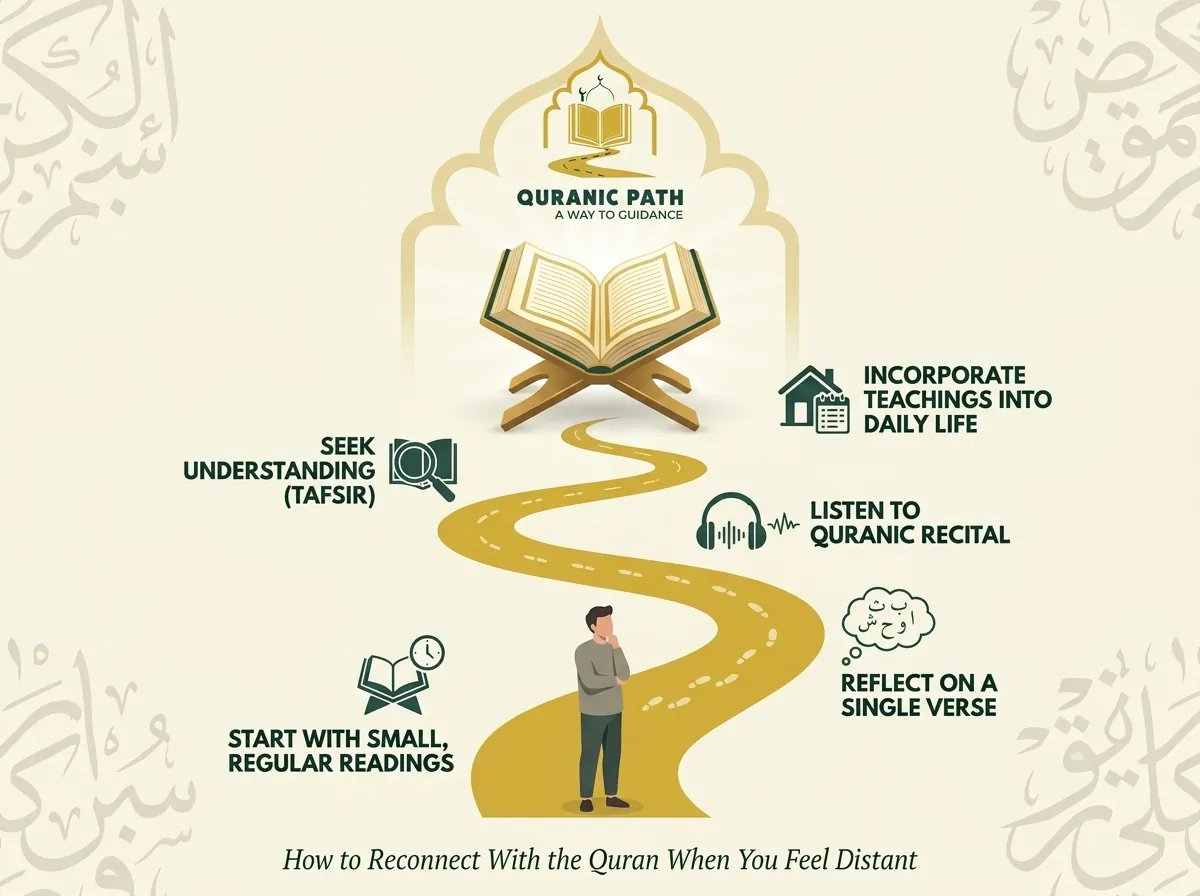
There is a particular kind of quiet heaviness that comes with realising you haven't opened the Quran in a long time. It's not usually a sudden decision to stop — it rarely is. Life gets busy, a few days become a few weeks, and at some point the gap itself starts to feel like the obstacle. Not the reading. The gap.
If that's where you are right now, this is written directly for you. Not for someone starting from zero, and not for someone deep in structured study — but for someone who already has a relationship with the Quran, who knows what it once felt like to read it regularly, and who isn't sure how to find their way back.
The honest news is that the way back is almost always smaller and simpler than it feels from the outside of the gap looking in.
Quick Answer: To reconnect with the Quran after feeling distant, let go of guilt about the time that has passed, open the Quran to any page, and read a small amount — even one page — without any pressure to catch up. Attach that small reading to something you already do daily, add a translation to understand the meaning, and let the habit rebuild gradually rather than all at once.
You Are Not Alone — Why Feeling Distant From the Quran Is So Common
It's worth saying plainly: this experience is far more common than it feels when you're inside it. Busy seasons of life, a house move, a new job, a new baby, a difficult period mentally or emotionally, or sometimes nothing dramatic at all — just the slow drift that happens when something isn't actively protected in a full schedule. The Quran is often one of the first things to quietly slip, precisely because it doesn't demand your attention the way a bill or a deadline does. It waits.
That waiting is not indifference on its part, and the length of your gap is not a verdict on your character or your faith. It's simply what happened. The only question that actually matters now is what happens next, starting today.
Let Go of the Guilt First — It's Blocking You More Than the Gap Itself
Here is something worth sitting with honestly: for most people, the guilt about not reading is a bigger barrier to starting again than the actual gap in reading ever was. Guilt tells you that before you can pick the Quran back up, you should feel appropriately bad about it, perhaps for a while, as some kind of prerequisite. It isn't. Guilt with no plan attached to it doesn't produce change — it just produces more avoidance, because facing the Quran starts to feel like facing your own failure rather than facing something restorative.
Allah says in the Quran: “...Verily, in the remembrance of Allah do hearts find rest.” (Surah Ar-Ra'd, 13:28). Notice what this verse doesn't say. It doesn't say hearts find rest once they've proven their consistency, or once enough time has passed to make up for a gap. It simply says remembrance brings rest — available the moment you return to it, gap or no gap.
A more useful way to hold the gap: it happened, it's now in the past, and it has no power over today except through the guilt you choose to keep carrying about it. Put the guilt down. It was never going to be the thing that got you reading again anyway.
Where to Start When You Haven't Opened the Quran in a Long Time
This question comes up constantly, and the anxiety behind it is usually about getting the "right" starting point — should you go back to where you left off? Start from the beginning? Pick something meaningful? Here is the honest answer: it doesn't matter nearly as much as it feels like it does.
- Open it to wherever it naturally falls open, or to a surah you already know well: Al-Fatiha, Al-Ikhlas, Ya-Sin — anything familiar removes the friction of feeling lost on page one.
- Don't try to find where you "left off": hunting for an old bookmark or trying to remember your exact place often becomes its own small barrier that delays starting by another day.
- Read slowly, without a target for that first sitting: the first return isn't about how much you cover. It's about the act of opening it again at all.
If even this feels like too much to decide, here is a genuinely fine default: open to Surah Al-Mulk, or Surah Ya-Sin, or simply the last surahs of the Quran (the shorter ones near the end) and read from there. There is no wrong door back in.
Start Small: Why the "One-Page Rule" Works Better Than a Big Plan
There's a common pattern worth naming directly, because it derails more comebacks than the initial gap ever does: someone decides to return to the Quran, feels motivated, commits to an ambitious daily amount to "make up for lost time," manages it for two or three days, and then the plan collapses under its own weight — followed by more guilt, and often a longer gap than the first one.
The one-page rule: commit to a single page a day. Not a juz, not several pages, not "as much as I can manage." One page. On days when you feel able to read more, read more — but the actual commitment, the non-negotiable one, stays at one page. This single change is often the difference between a habit that survives its first difficult week and one that doesn't.
This isn't about lowering your ambition for the Quran. It's about recognising that a small, sustained habit compounds into something much larger over months, while an ambitious plan that collapses after four days compounds into nothing at all except another attempt to feel guilty about.
Building a Simple, Realistic Quran Routine
A routine that depends on remembering, deciding, or finding motivation fresh each day is fragile by design — it relies on willpower, which fluctuates constantly. A routine that attaches itself to something already fixed in your day is far more durable, because the existing habit does the remembering for you.
Attach Reading to an Existing Habit
Straight after Fajr, right after Maghrib, or the moment you sit down with your morning tea — pick a moment that already happens automatically every day, and place your page there. You stop needing to remember; the existing habit reminds you.
Keep the Mushaf Somewhere Visible
A Quran left on a shelf across the room is easy to forget. A Quran left open or visible near where you already sit each day is a quiet, constant invitation rather than something you have to actively seek out.
Never Let a Day Go to Zero
On a genuinely difficult day, reading three verses instead of a full page is a win, not a failure. The habit survives on the floor being protected — never skipping entirely — far more than on hitting an ideal target every single day.
How Much Should You Read Each Day When Starting Again?
Less than feels ambitious — genuinely. The instinct after a long gap is to want to prove something, to yourself if no one else, by starting big. But the evidence of what actually sustains a habit points the other way: small and boring and repeated beats large and impressive and abandoned by the second week.
A realistic starting range: one page a day is the baseline that rebuilds the habit itself. If a page feels genuinely light after a couple of weeks, let it grow naturally — two pages, then perhaps half a juz on good days. But resist the urge to set that larger number as day one's target. The goal in the first month isn't volume. It's making the habit boringly reliable again.
"I Read It But I Don't Understand It" — Bridging the Meaning Gap
This is one of the quieter reasons people drift away from the Quran in the first place, and it's worth addressing directly rather than skipping past. Reciting words in a language you may not fully understand can start to feel mechanical after a while — going through the motion of reading without a strong sense of what's actually being said. That flatness is not a personal failing. It's simply what happens when recitation and understanding are separated for too long.
The good news is that this gap is very fixable, and doesn't require becoming an Arabic scholar first. Reading a page in Arabic and then reading the same page's meaning in a clear Quran Translation takes only a few extra minutes, and it changes the entire character of the reading — from repetition to reflection. Over time, some people go further and study Tafseer, which explains the context and deeper meaning behind verses, turning a single page into something you could sit with for much longer than the few minutes it takes to recite.
A small but meaningful shift: you don't need to add translation to every page from day one. Even reading the meaning of one verse that stood out to you that day is enough to start noticing the Quran speaking to your actual life again, rather than passing through you unnoticed.
For a broader sense of how recitation, meaning, and the wider Quran learning journey fit together, our complete guide to learning Quran online covers how these pieces connect for learners at every stage, not only complete beginners.
Can a Teacher or Class Help You Stay Consistent?
For some people, personal willpower and a simple routine are genuinely enough to sustain a habit long-term. For many others — and there's no shame in this at all — a fixed weekly class or a teacher creates a kind of gentle external structure that's very difficult to build alone, especially in the weeks when motivation naturally dips.
A regular class does a few specific things that a solo habit often can't: it puts a fixed point in your week that doesn't depend entirely on your own memory or mood, it gives you someone to ask when a verse or a Tajweed rule doesn't make sense, and for many people, simply knowing someone else is expecting them at a certain time is enough to protect that time when everything else in the week is competing for it.
This isn't necessary for everyone, and it isn't the only valid way back to the Quran. But if you've tried to rebuild a personal habit alone several times and it keeps slipping, structured support — whether through one-to-one classes, a local class, or a dedicated Islamic Studies course for wider context — is a reasonable and often effective thing to lean on, not a sign that you couldn't do it "properly" by yourself.
If Structure Would Help, We're Here
Some people rebuild their Quran habit alone, and that's genuinely enough. If you'd find it easier with a little gentle structure and a teacher to guide the way back, Quranic Path offers 3 completely free trial classes — no pressure, no commitment, just a starting point if you want one.
Explore 3 Free Trial Classes Or browse our courses in your own time firstMaking the Quran Part of Daily Life, Not a Separate Project
One of the quiet reasons the Quran becomes easy to drop is that it can end up filed mentally as a "spiritual project" — something separate from ordinary daily life, reserved for good days, quiet moments, or Ramadan, rather than woven into an ordinary Tuesday. Projects have a start and an end. A daily relationship doesn't need either.
The shift that helps most people is small: instead of treating your daily page as a task to complete, let whatever you read that day sit quietly in the back of your mind as you go about the rest of it. A verse about patience read in the morning can quietly reframe a frustrating moment at work that afternoon. That's not a coincidence or a special spiritual state — it's simply what happens when the Quran is present in daily life rather than boxed off from it.
Over time, some people extend this further — exploring Islamic Studies to understand the wider context the Quran sits within, or studying Tafseer to go deeper into specific verses that matter to them. None of that needs to happen immediately. The daily page, read consistently, already is the relationship. Everything else is simply going deeper into something you've already returned to.
Frequently Asked Questions
Start by letting go of any guilt about the time that has passed, then open the Quran and read a small amount without any pressure to catch up or make up for lost time. Reconnection happens through small, repeated moments, not through one dramatic return. The relationship rebuilds itself gradually once you simply begin again.
Open it to any page and read slowly, with no target beyond that single moment. There is no requirement to start from where you left off, to finish a certain amount, or to explain the gap to anyone, including yourself. The length of the gap has no bearing on whether you're allowed to start again today.
Make the first step deliberately smaller than feels necessary — a single page, or even a few verses, is enough. Overwhelm usually comes from an unspoken plan to "catch up" or read a large amount to compensate for lost time. Removing that expectation entirely is what makes starting again feel possible.
Attach a small, fixed amount of reading to something you already do every day without fail, such as straight after a prayer or right after waking up. A routine that depends on remembering or deciding fresh each day tends to fail; one that rides on an existing habit tends to stick.
Less than feels ambitious. One page a day, sustained for a month, rebuilds the habit far more reliably than several pages a day that lasts only a few days before stopping. The daily amount can grow naturally later, once the habit itself is secure.
This is extremely common and not a sign you're doing something wrong. Reading alongside a clear translation, even for just the portion you read that day, turns the words into something you can reflect on rather than only recite. Understanding can be built up gradually alongside recitation rather than needing to be mastered first.
For many people, yes. A regular class creates a fixed point in the week and gentle accountability that's hard to replicate alone, especially in the weeks when personal motivation dips. A teacher can also answer questions about meaning and correct recitation in a way that self-study alone cannot.
Treat it as a small, ordinary part of the day rather than a separate spiritual project reserved for good days or Ramadan. Reading a little, reflecting briefly on its meaning, and letting that understanding sit in the back of your mind through the day is what turns the Quran from an occasional task into a genuine daily presence.
The Gap Ends the Moment You Open It Again
Every long gap with the Quran ends the same simple way — not with a perfect plan, not with the right amount of guilt processed, not with finding exactly the right moment. It ends when the page is opened again, however small that first reading is.
You don't need to explain the gap. You don't need to make up for it. You only need today's page — and today's page is enough.
The Prophet Muhammad ﷺ said: “The one who reads the Qur'an and is proficient with it will be with the noble, honourable scribes (angels), and the one who reads the Qur'an and finds it difficult, struggling with it, will have a double reward.” (Bukhari and Muslim). Coming back after a long gap, a little rusty, reading slowly and imperfectly, is not a lesser return. It is, in its own way, doubly counted.