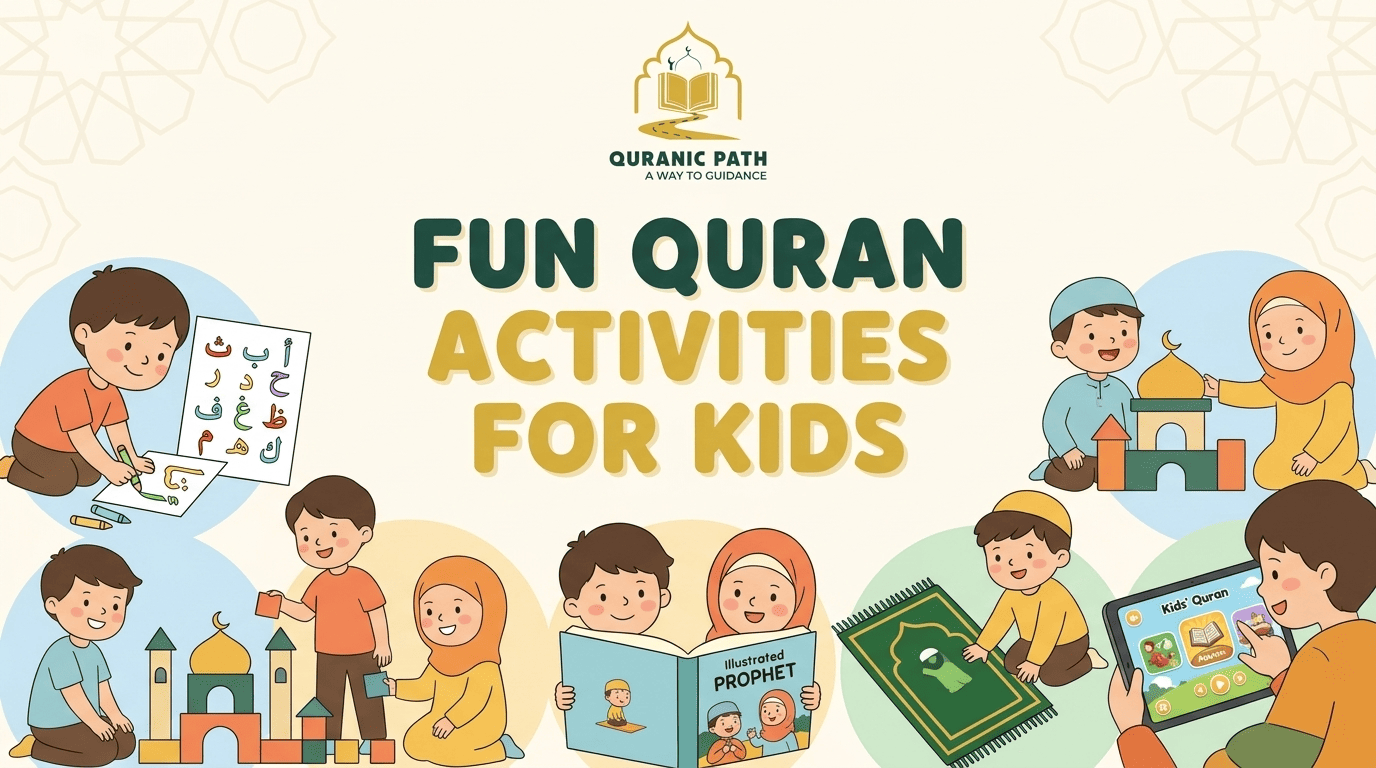
The challenge every Muslim parent in the UK, USA, Canada, and Australia faces is the same: how do you build genuine love for the Quran in a child growing up surrounded by screens, school pressure, and a hundred competing demands for their attention?
The answer — consistently supported by both child development research and 1,400 years of Islamic parenting wisdom — is not stricter enforcement. It is association. Children who associate the Quran with warmth, play, and family connection carry that relationship into adulthood. Children who associate it only with correction and obligation often drift away the moment they have the independence to choose.
This guide gives you 25 activities, organised by age, that build the right association — without requiring you to read Arabic, buy expensive materials, or set aside hours you don't have.
Quick Answer: Children who associate the Quran with fun, warmth, and family — not obligation and pressure — are significantly more likely to maintain a lifelong connection to it. The most effective approach combines passive daily habits (background recitation, bedtime surahs) with one structured weekly activity matched to your child's age, alongside formal one-to-one Quran classes.
Activities for Ages 3–5: Making Arabic Feel Natural
At this age the goal is not reading or memorisation — it is making Arabic and Quranic sounds feel completely normal and joyful, the same way a child absorbs their mother tongue before ever learning grammar.
Ages 3–5 — 6 Activities
Bedtime Surah Routine
Choose 3 short surahs (Al-Ikhlas, Al-Falaq, An-Nas) and recite them together every single night before sleep. Consistency matters more than length — even 90 seconds nightly builds permanent memory and a calming bedtime association.
Quran as Background Audio
Play a recognised Qari (Sheikh Mishary, or kid-friendly apps like Tarteel) as ambient background during breakfast, car journeys, or playtime. No active engagement required — passive exposure builds familiarity with Quranic sound patterns.
Bismillah Before Everything
Say Bismillah together — loudly, cheerfully — before every meal, car journey, drawing session, or new activity. This builds the habit of remembering Allah before action, the foundation of mindful living.
Arabic Letter Playdough
Use playdough or clay to form Arabic letters together. Show the letter, say its name aloud, make it together. No writing pressure — just tactile, joyful familiarity with the alphabet shapes.
Prophet Stories at Bedtime
Replace one regular storybook night per week with a short, age-appropriate story of a Prophet — Ibrahim, Yunus, or Musa. Children absorb character and courage through story long before they understand doctrine.
Surah Reward Chart
A simple wall chart with star stickers. Every time the child recites a surah they know — unprompted — they add a star. No pressure, just visible, joyful progress they control themselves.
Activities for Ages 6–9: Reading Begins
This age group is typically working through formal Noorani Qaida and early Quran reading. Activities at this stage should reinforce — never replace — what their teacher is covering in class.
Letter Sound Bingo
Create a 4×4 grid of Arabic letters they know. Call out letter sounds — children mark the letter. First to a full row wins.
Surah Hopscotch
Draw hopscotch squares with words from a surah they're memorising. Child hops and recites each word in order.
Surah Jigsaw
Write an ayah on card, cut into word-sized pieces, mix up. Child reassembles the ayah in correct order from memory.
Islamic Art + Colouring
Print Islamic geometric patterns or Arabic letter colouring pages. Play Quran recitation quietly in the background.
"Be the Teacher" Game
Let the child teach you the surah they learned this week. Ask them to "correct" your deliberate mistakes — they love it.
Prophet Story Map
Draw a simple map showing where each Prophet lived and journeyed. Add to it as new stories are learned.
Pair These Activities With a Certified Teacher
These games build love for the Quran — a qualified teacher builds the skill to read it correctly. Book 3 free one-to-one trial classes for your child today. No commitment, no card required.
Book 3 Free Trial Classes Ijazah-certified teachers · Ages 3 to teen · UK, USA, Canada & AustraliaActivities for Ages 10–14: Depth and Independence
Older children need activities that respect their intelligence, connect to their daily life, and give them genuine ownership of their own Quran journey — not just tasks assigned to them.
Ages 10–14 — 7 Activities
Quran Reflection Journal
After reading a passage, write one sentence: "What did this ayah make me think about?" No right or wrong answers — just genuine personal reflection that builds a real relationship with meaning, not just memorisation.
Voice Recording Comparison
Record the child reciting 3 verses. Play it back alongside the same verses from Sheikh Husary or Sheikh Mishary. Self-comparison is far more motivating than parental correction at this age.
Quran Word Treasure Hunt
Give a word they know from the Quran — e.g., رَحْمَة (mercy) — and challenge them to find it in three different surahs using a Quran app or printed Mushaf with an index.
Hadith + Quran Connection
Choose a hadith the child knows — about honesty, kindness, or patience — and challenge them to find an ayah that connects to the same theme. Builds the link between Sunnah and Quran naturally.
Lead the Family Prayer
From age 10–11, invite the child to lead a voluntary (Nafl) Salah for the family at home — reciting surahs they've memorised. A genuine milestone moment that builds confidence and pride.
Personal Hifz Progress Dashboard
Let the child build and own their own progress tracker — a notebook, phone note, or simple spreadsheet listing what they've memorised. Ownership at this age dramatically improves motivation.
Quran in the News
Once a week, connect a Quranic ayah to something happening in the world. "We talked about patience in Al-Asr — how does that apply to what's happening today?" Makes the Quran feel relevant, not historical.
How Activities Pair With Online Classes
These activities are not a replacement for structured online Quran classes — they are a multiplier. Here is exactly how to pair them for maximum effect:
Reinforce What the Teacher Taught
After each online class, do one activity based on exactly what was covered. If the teacher introduced Ba, Ta, Tha that week, play Letter Sound Bingo with those three letters specifically.
Weekly Rhythm, Not Daily Pressure
One structured activity per week plus the daily passive habits (background Quran, Bismillah, bedtime surahs) is the optimal balance — enough to reinforce, never enough to feel like a chore.
Make Siblings Do It Together
Wherever possible, involve all children in the same activity regardless of level. Younger children benefit from hearing older siblings recite; older children build patience and leadership by helping.
Never Use Activities as Tests
The moment an activity starts to feel like an assessment — a right answer, a mark, a consequence for getting it wrong — it stops working as a love-building tool. Keep formal correction inside the structured class.
For UK families specifically: These activities work especially well alongside structured one-to-one online Quran classes — fitting around a busy UK school timetable without adding pressure on weeknights. Our certified teachers provide the formal Tajweed and reading foundation; these activities build the love that makes that foundation stick for life.
Key takeaways for parents: Children who associate Quran with warmth and play maintain lifelong recitation far more reliably than those raised under pressure. Ages 3–5: passive audio exposure + bedtime surahs + Bismillah habit, no formal pressure. Ages 6–9: games, movement, and storytelling that reinforce what the teacher has taught. Ages 10–14: ownership, self-reflection, and real-world connection. One structured activity per week plus daily passive habits is the optimal home Quran rhythm — and these activities multiply the effectiveness of online classes, they never replace them.
Give Your Child the Formal Foundation They Need
Our Ijazah-certified teachers provide structured, one-to-one Quran instruction that pairs perfectly with the activities above — building both skill and love together, from your home in the UK or anywhere worldwide.
View Our Courses Or book 3 free trial classes — no card requiredFrequently Asked Questions
Active children learn best through movement and games — not sitting at a desk. Surah Hopscotch, Letter Sound Bingo, and the Quran Word Treasure Hunt all build Quran learning into physical activity. The goal at this stage is not stillness — it is positive association. A child who runs around shouting Arabic letter sounds is learning just as effectively as one sitting quietly, often more so.
Yes — but the root cause also needs addressing. Children disengage from large mosque group classes primarily because of pace mismatch and lack of one-to-one correction. These home activities rebuild positive association alongside formal learning, but for UK families specifically, switching to one-to-one online classes where pace is matched exactly to your child often solves the boredom problem at its source.
One structured activity per week is the recommended frequency, combined with daily passive habits such as background Quran audio, the Bismillah habit, and bedtime surah recitation. More than one structured activity per week begins to feel like pressure rather than play, which works against the goal of building genuine love for the Quran.
None of these activities require the parent to read Arabic. Background audio, bedtime surah repetition, Bismillah habits, reward charts, and reflection journals all work regardless of the parent's own Arabic ability. For activities that involve correcting pronunciation, that responsibility belongs with a qualified Ijazah-certified teacher — your role at home is encouragement and consistency, not correction.
Yes. These activities are designed for any English-speaking household and work particularly well for UK Muslim families balancing school, weekend mosque classes, and family life. Many UK parents use the weekly rhythm suggested here — one activity on a weekend afternoon, daily passive habits during the school week — to fit Quran learning around a busy UK school timetable without adding pressure.
Conclusion: Build the Love, the Skill Will Follow
None of these 25 activities require expensive materials, Arabic fluency, or hours of free time. What they require is consistency and the right mindset: the Quran is not a subject to be mastered under pressure — it is a relationship to be nurtured with warmth.
Start with one activity this week, matched to your child's age. Pair it with structured, one-to-one online classes for the formal Tajweed and reading foundation. Within months, you will see the difference between a child who is made to read Quran and a child who genuinely wants to.
The Prophet Muhammad ﷺ said: "The best among you are those who learn the Quran and teach it." (Bukhari). Every bedtime surah, every silly game, every shared moment of Bismillah is a small act of teaching — and every one of them counts.