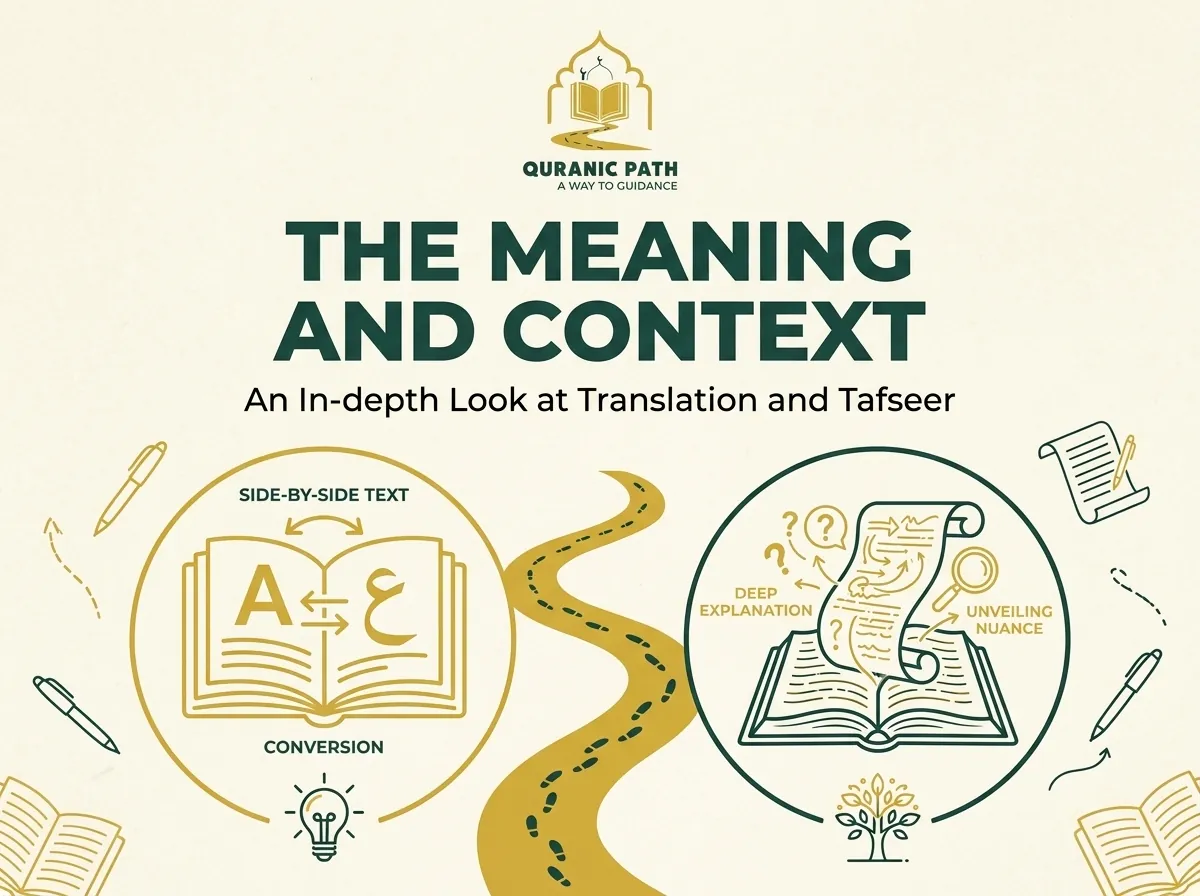
"I read the translation, so I understand the Quran now." It's a completely understandable thing to think, and for a first step, it's genuinely true — translation is real understanding, not a lesser substitute for it. But many people use "translation" and "Tafseer" as though they're the same word for the same thing, and once you see the difference clearly, it changes how you read, what you notice, and how much further you realise there is to go.
This isn't a technical distinction reserved for scholars. It's a genuinely useful thing for every Quran reader to understand, because it answers a question many people quietly wonder about: am I actually understanding this, or just reading words in my own language? Often, the honest answer is: a bit of both — and that's completely fine as a starting point.
Quick Answer: Quran Translation renders the Arabic words into another language, giving the surface-level meaning of a verse. Tafseer is scholarly explanation that goes further — covering the context of revelation, linguistic depth, and how a verse connects to other verses and to Hadith. Translation tells you what the words say. Tafseer explains what they mean.
They Are Not the Same Thing — and the Difference Actually Matters
Here is the clearest way to hold the distinction in mind: translation tells you what the words say. Tafseer tells you what they mean. Those sound similar, but they are genuinely different jobs.
A translation is a fixed, relatively short rendering — it takes the Arabic words of a verse and gives you their closest equivalent in another language. A Tafseer is an explanation — sometimes running to several pages for a single verse — that unpacks the context it was revealed in, the precise meaning of key words, how it relates to other verses, and what scholars across history have understood it to mean.
Why this matters practically: if you only ever read translation, you're getting a real but necessarily compressed version of the Quran's meaning. That's not a criticism of translation — it's simply what translation, by its nature, can and can't do. Knowing that helps you read with the right expectations, and helps you know when it's worth reaching for something more.
What Is Quran Translation, Exactly?
Quran Translation takes the Arabic text of the Quran and renders it into another language — English, Urdu, French, or any other — as accurately and directly as the translator can manage. The goal is to let someone who doesn't read Arabic follow the meaning of what's being recited.
Good translations are careful, scholarly work, not casual paraphrase. But translation faces an inherent limitation that has nothing to do with the translator's skill: Arabic, and Quranic Arabic in particular, often carries multiple layers of meaning, grammatical emphasis, and shades of sense in a single word that don't map cleanly onto a single word in another language. A translator has to choose one rendering, which means some of that richness is set aside in favour of clarity and readability — a completely reasonable trade-off, but a real one.
This is exactly why the Quran itself is traditionally regarded as untranslatable in the fullest sense — what you're reading in English is best understood as a translation of the meaning of the Quran, not the Quran itself, which remains, in its precise linguistic form, in Arabic.
What Is Tafseer, in Simple Words?
Tafseer (تفسير) means "explanation" or "exegesis." In practice, it is the body of scholarly work that explains what a verse means, drawing on several kinds of knowledge a translation alone can't carry:
- The context of revelation: where known, the circumstances or events that a verse was revealed in response to, which often sharpens exactly what it's addressing.
- Linguistic depth: the fuller range of meaning carried by the original Arabic words, including nuances that a single translated word cannot fully capture.
- Connections to other verses: the Quran frequently explains or expands on itself elsewhere, and Tafseer traces those connections.
- Related Hadith: authentic sayings of the Prophet Muhammad ﷺ that clarify or elaborate on a verse's meaning.
- The understanding of early scholars: built up and passed down over centuries, often through well-known works such as those of Ibn Kathir or Al-Tabari, among many others.
Put simply: if translation is a sentence, Tafseer is the fuller explanation of that sentence — what prompted it, what it's really getting at, and how it fits into the bigger picture.
A Real Example: The Same Verse, Two Levels of Understanding
Abstract definitions only go so far. Here is an actual example, using one of the most recited verses in the Quran — from Surah Al-Fatiha, recited in every unit of every prayer.
What Translation Gives You
A clear, complete sentence: a request to Allah for guidance along a path described as straight. Read on its own, most people take "the straight path" to mean, in general terms, the path of righteousness or correct guidance — which is true, but leaves an open question: guidance toward what, exactly, and guided like whom?
What Tafseer Adds
Tafseer points to how the Quran itself answers that question a few surahs later, in Surah An-Nisa (4:69), describing "the straight path" as the path of those Allah has favoured — the Prophets, the truthful, the martyrs, and the righteous. Read alongside that, the short request in Al-Fatiha becomes something far more specific: not a vague wish for general goodness, but a prayer to be placed among a particular, described company. That connection is invisible in the translation alone.
Notice what happened there: the translation was not wrong, and nothing about it was misleading. It simply couldn't, on its own, show the connection to another verse that gives the phrase its fuller shape. That is the entire difference in a single, everyday example — and it's why the same short verse, recited dozens of times a day by any praying Muslim, can be understood at meaningfully different depths.
Why Tafseer Matters — What Translation Alone Can Miss
The Al-Fatiha example is a gentle one. In many other places across the Quran, the gap between translation and Tafseer is larger — a verse's historical context can completely reshape how a general statement is meant to be applied, or a single Arabic word can carry a specific legal, spiritual or historical meaning that no single English word fully captures.
This isn't a flaw in the Quran or in translation — it's simply the nature of moving between languages, especially with a text as linguistically dense as the Quran. Tafseer exists precisely to recover what would otherwise stay hidden inside the original Arabic.
Reflection of the kind this verse describes is difficult to do on translation alone, precisely because reflection needs the fuller picture — the context, the connections, the reasoning — that Tafseer is built to provide.
Can You Understand the Quran Through Translation Alone?
Yes, genuinely — and it's worth saying this plainly, because some people feel that reading "only" translation somehow doesn't count. It counts. Translation gives real understanding: the general message, the guidance, the stories, the warnings and the reassurances. For daily reading, for a first pass through a surah, for following along during prayer, translation on its own is a completely legitimate and valuable way to engage with the Quran.
What translation alone typically can't give you is the full depth available in a verse — the historical context, the precise legal or linguistic nuance, the web of connections across the wider Quran. Whether that additional depth matters to you depends on what you're trying to do: casual daily reading may need nothing more than a good translation, while deeper study of a specific topic or verse usually calls for Tafseer. Neither is a "better" way to engage with the Quran in an absolute sense — they simply serve different purposes.
Do You Need Arabic to Study Tafseer? Can Beginners Start?
No, you don't need Arabic first, and yes, beginners can genuinely start. This surprises people, because Tafseer sounds like advanced scholarly territory reserved for those fluent in classical Arabic. In reality, many well-regarded Tafseer works exist in translation, written specifically to be accessible to readers without Arabic.
That said, two things help beginners get the most out of it:
- Start with shorter, well-known surahs rather than diving into the most detailed volumes on the longest chapters. A clear explanation of Surah Al-Ikhlas or Surah Al-Asr is a far friendlier starting point than an exhaustive multi-volume commentary.
- Study with guidance where possible. A teacher who can answer questions and point out where scholars differ or agree makes dense material far more approachable than working through it entirely alone.
Learning some Arabic does open a further layer of access over time — certain explanations rest on a specific word's grammatical form or root meaning, which lands differently once you can see it in the original. But that is an enhancement to build toward, not a locked door standing in front of beginners.
Reading the Quran vs Understanding Its Meaning: Two Different Skills
It's worth being explicit about a distinction that often gets blurred: reading the Quran and understanding it are two separate skills, developed through two different kinds of study.
Reading the Quran
This is about correct pronunciation of the Arabic text — built through Noorani Qaida and Tajweed. A person can recite beautifully and accurately without yet knowing what a single word means.
Understanding Its Meaning
This is about grasping what the words say and mean — built through Translation, and taken further through Tafseer. It's entirely possible to develop this without perfect Arabic pronunciation.
Both are genuinely valuable, and neither makes the other unnecessary. Many students learn them side by side rather than treating one as a prerequisite for the other — reciting the Arabic in prayer while separately studying what that same passage means through translation and, later, Tafseer.
How Translation, Tafseer and Arabic Fit Together in a Learning Journey
At Quranic Path, we think of this less as a checklist and more as a widening circle: learn the Quran, understand its guidance, and grow through it. Translation, Tafseer, and Arabic Language aren't three unrelated subjects — they're different depths of the same journey toward that understanding, and a student can move through them in whatever order suits their own goals.
Quran Translation
The most immediate way in. No Arabic required, and it turns recitation into something you can reflect on right away, in your own language.
Tafseer-e-Quran
Adds context, connection, and scholarly depth to verses you already have a general sense of from translation — the "why" and "how it all fits" behind the words.
Islamic History & Studies
Places verses and their Tafseer within the broader story of Islamic history and the life of the Prophet ﷺ, so meaning connects to a fuller picture rather than sitting in isolation.
Arabic Language
Eventually opens the ability to engage with the Quran's own words directly, rather than through translation or explanation alone — the deepest layer, built over time rather than all at once.
None of these need to happen at once, and none of them make recitation or Tajweed less important — they sit alongside it. If you've already started reading regularly and want to take the next step toward meaning, our guide on building a deeper relationship with the Quran touches on exactly this same idea from a different angle.
Ready to Go Beyond Translation?
Whether you want to start with Quran Translation, go deeper with Tafseer, or explore Islamic History and Arabic Language, Quranic Path offers 3 completely free trial classes to find the right starting point for you.
Book 3 Free Trial Classes Or explore our full course list firstFrequently Asked Questions
Translation renders the words of the Quran into another language as directly as possible, giving the surface-level meaning of a verse. Tafseer is scholarly explanation that goes further — covering why a verse was revealed, how its words are understood in context, and how it connects to other verses and to Hadith. Translation tells you what the words say; Tafseer explains what they mean.
Tafseer is the scholarly explanation of a Quranic verse — covering its context, the circumstances of its revelation where known, its deeper linguistic meaning, and how earlier scholars have understood it. Think of it as the difference between reading a single sentence and having someone knowledgeable explain the full story and reasoning behind it.
Tafseer is important because many verses carry historical context, linguistic nuance, or connections to other parts of the Quran that a translation alone cannot fully convey. Without it, a reader may understand the general sense of a verse but miss why it was revealed, what problem it was addressing, or how it relates to guidance found elsewhere in the Quran.
Translation alone gives a genuine and valuable level of understanding, and it is a completely legitimate place to start or to stay for general reading. However, it typically cannot capture everything a verse's original Arabic wording carries — layered meanings, grammatical emphasis, and historical context — which is where Tafseer adds real depth for those who want to go further.
No — many well-regarded Tafseer works are available in translation, and a great deal of meaningful Tafseer study is entirely possible without first learning Arabic. Knowing Arabic does add another layer of access, particularly to the linguistic reasoning behind certain explanations, but it is not a prerequisite to begin.
Yes. Beginners are usually best served by starting with clear, accessible Tafseer of shorter, well-known surahs rather than the most detailed classical volumes, and by studying with guidance rather than navigating dense scholarly texts entirely alone. Understanding builds gradually, the same way recitation and Arabic do.
Reading the Quran refers to reciting its Arabic text correctly, which is a skill built through Tajweed and practice. Understanding its meaning is a separate skill, built through translation and Tafseer. A person can recite fluently without yet understanding the meaning, and both are valuable — but they develop through different kinds of study.
Translation opens the door to meaning immediately, without requiring years of Arabic study first. It lets a reader follow the general sense, message and guidance of a verse in their own language, turning recitation from sound alone into something they can reflect on — even before going deeper into Tafseer or Arabic.
Translating a verse converts its words into another language. Tafseer explains the verse — drawing on the context of revelation, connections to other verses and Hadith, and the scholarly understanding built up over centuries. A translation is generally a single, fixed rendering; a Tafseer is an explanation that unpacks layers a translation alone leaves closed.
The Goal Was Never Just to Finish Reading
Translation and Tafseer are not competitors, and neither is the "correct" way to engage with the Quran. They're two depths of the same pursuit — one that opens the door to meaning quickly, and one that keeps opening further doors behind it, for as long as you're willing to keep studying.
If you've only ever read translation, that is real, valid understanding — not a lesser version of the Quran. But now you know there is more available whenever you're ready to reach for it: context, connection, and centuries of scholarship, waiting behind the same verses you already read.
Learning the Quran was never only about finishing its pages. It is about understanding its guidance, and growing through what it teaches — and that is a journey translation and Tafseer, together, are built to carry you through.