Among the stories preserved in the Holy Quran, few carry the weight, depth, and universal relevance of the story of Prophet Adam (عَلَيْهِ ٱلسَّلَامُ). It is the beginning of the human journey — a narrative of divine purpose, free will, deception, repentance, and ultimate hope. Unlike myths or folklore, the Quranic account is presented as divine truth, referenced across multiple chapters and corroborated by the sayings of the Prophet Muhammad ﷺ.
The short answer: The story of Prophet Adam (عَلَيْهِ ٱلسَّلَامُ) is the foundational story of humanity in the Quran — covering his creation from clay, the breathing of the soul, the angels' prostration, the test of Paradise, his repentance, and the establishment of humanity on Earth. It is told across 7 surahs and contains the essential lessons of free will, accountability, and Allah's infinite mercy.
This article walks through the complete story — from the moment Allah ﷻ announced His intention to create a Khalifah on Earth, through to Adam's life, trials, and eventual death — drawing exclusively from Quranic ayat and authenticated narrations.
Allah Announces the Creation of a Khalifah
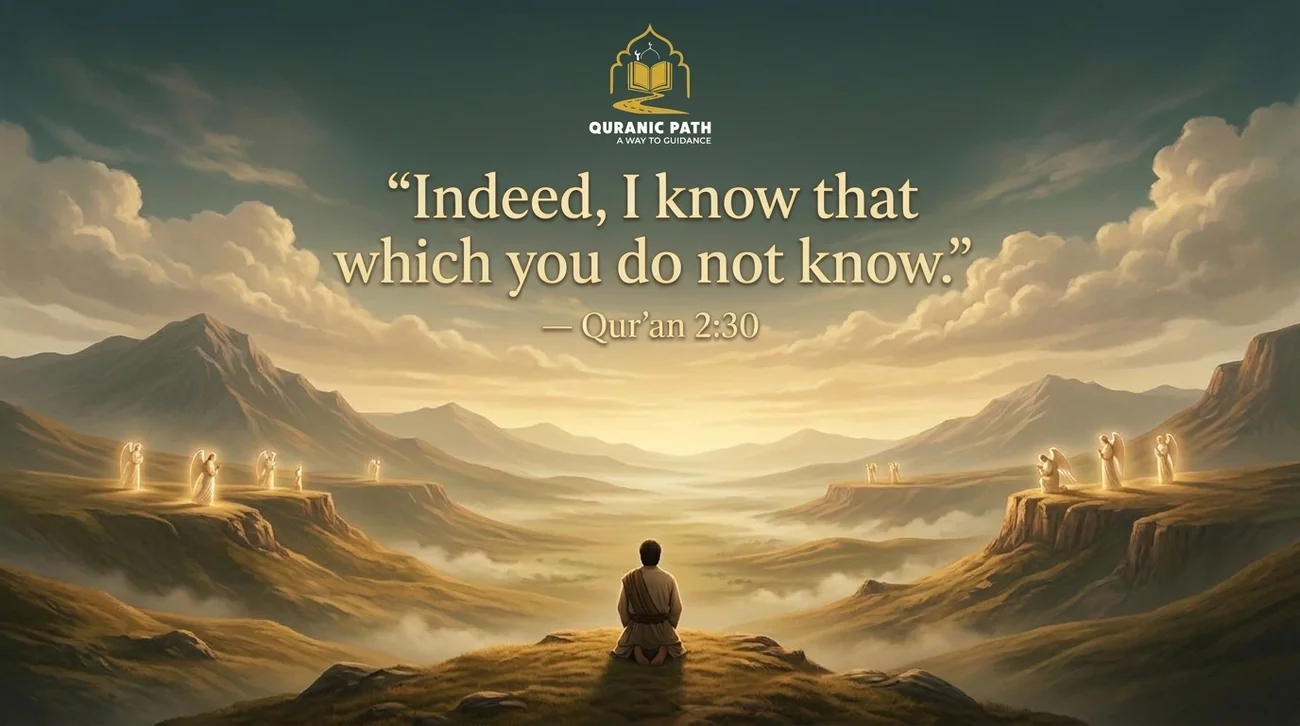
Before a single atom of Adam (عَلَيْهِ ٱلسَّلَامُ) had been shaped, Allah ﷻ addressed His angels with a momentous announcement: He intended to place a Khalifah upon the Earth. The word Khalifah (خَلِيفَة) means a vicegerent, a trustee, or a successive authority — someone entrusted with the stewardship of the Earth across generations.
The angels — beings created from light, devoted entirely to the worship of Allah and utterly obedient to His every command — responded with a question rooted not in rebellion, but in genuine wonder. They asked whether this new creation would bring corruption and shed blood upon the Earth, while they themselves already glorified Allah perfectly.
Scholars of Quranic commentary clarify that the angels' question was not a challenge to Allah's will. They spoke from sincere curiosity, consistent with their nature: "They do not speak until He has spoken, and they act only by His command" (Surah Al-Anbiya, 21:27). Allah's response — "Indeed, I know that which you do not know" — was a reminder that divine wisdom is beyond the reach of angelic understanding.
The Creation of Adam (عَلَيْهِ ٱلسَّلَامُ)
With the divine decree in place, Allah ﷻ fashioned the first man from clay gathered from different parts of the Earth. This detail is deeply significant: it explains why the descendants of Adam differ in complexion, stature, and temperament — each reflecting the varied soils from which their ancestor was drawn.
The Prophet Muhammad ﷺ also described Adam's (عَلَيْهِ ٱلسَّلَامُ) stature as sixty cubits in height — a figure scholars interpret as referring to his form in Paradise, with human stature diminishing through generations thereafter (Sahih Bukhari, 3326). For forty years, the clay figure of Adam lay lifeless. During this time, Iblis — a jinn of great standing who dwelt among the angels — visited this motionless form gripped by envy, striking it and taunting what he clearly feared would become his superior.
The Soul is Breathed In & the Angels Prostrate
When the appointed moment arrived, Allah ﷻ breathed His created soul into Adam (عَلَيْهِ ٱلسَّلَامُ), and life entered him. At the very first sensation of that soul, Adam sneezed and instinctively said: "Alhamdulillah" — all praise is for Allah. Allah responded with mercy, and with those first words, the tradition of praising Allah upon sneezing was established for all his descendants (Jami at-Tirmidhi, 3367).
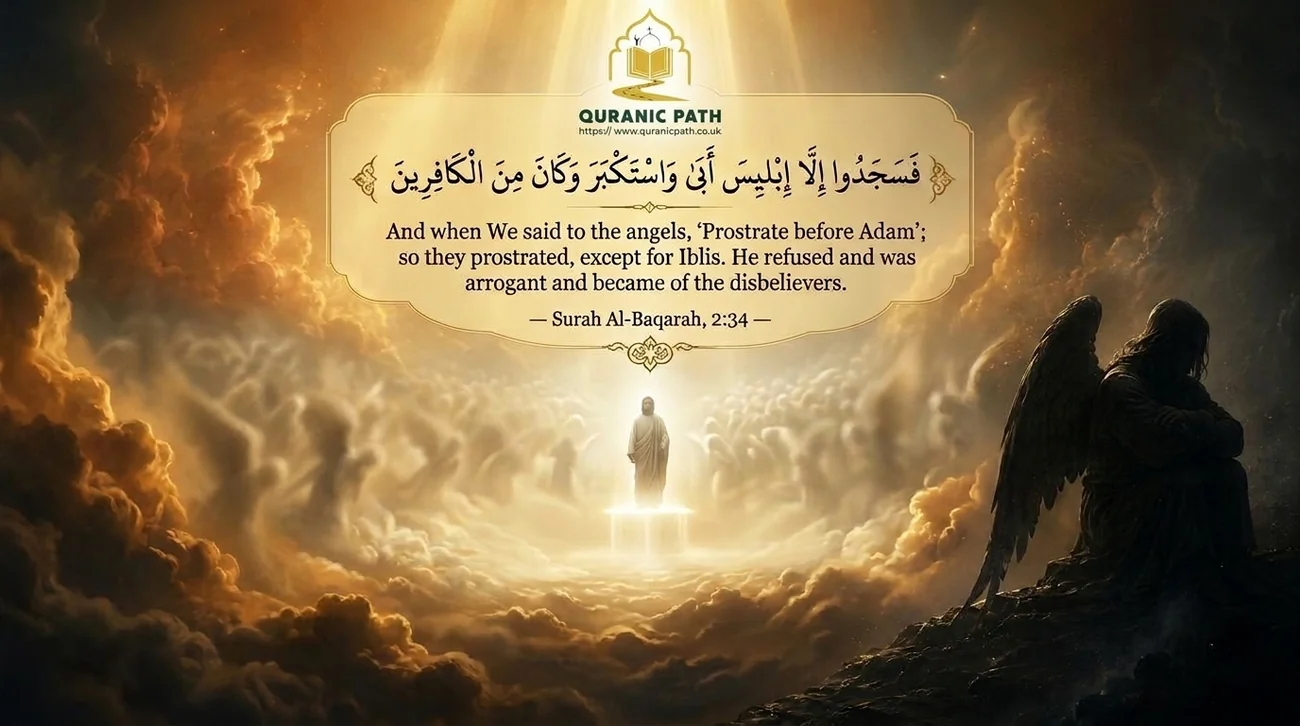
Allah ﷻ had already commanded the angels: "When I have proportioned him and breathed into him of My [created] soul, then fall down to him in prostration" (Surah Sad, 38:72). Every angel obeyed — every one except Iblis.
A common question: if Iblis was not an angel, why was he expected to prostrate? Surah Al-Kahf (18:50) clarifies that Iblis was from the jinn, not the angels. He had risen to great devotion and dwelt among them — which is why the command applied to him too. Unlike angels who have no free will, Iblis as a jinn could choose, and he chose arrogance over obedience.
The Arrogance of Iblis & His Expulsion
When Allah ﷻ questioned Iblis — "O Iblis, what prevented you from prostrating to that which I created with My own hands?" — his answer laid bare the poison of pride. He declared himself superior: fire, he claimed, was nobler than clay, and therefore he was inherently greater than Adam (عَلَيْهِ ٱلسَّلَامُ).
This was not merely incorrect reasoning — it was the very definition of kibr (arrogance): evaluating creation by the material from which it is made, rather than the honour Allah chose to bestow upon it. Iblis applied his own limited judgement to a matter of infinite divine wisdom. Allah ﷻ cast him out: "So get out — you are truly cursed" (Surah Al-Hijr, 15:34).
Expelled but granted respite until the Day of Resurrection, Iblis made a vow: he would dedicate himself entirely to misleading humanity — whispering, deceiving, and making disobedience appear beautiful. Allah ﷻ granted the respite while warning that His sincere servants would be beyond Iblis's reach.
Adam Learns the Names of All Things
Allah ﷻ distinguished Adam (عَلَيْهِ ٱلسَّلَامُ) from every other creation by endowing him with comprehensive knowledge of names. Scholars differ on precisely what this encompassed — the names of all creatures, objects and concepts; the structure of language itself with all its nouns, verbs, and expressions; or perhaps the understanding of all things and their characteristics. All three interpretations point to one truth: humanity was gifted a depth of knowledge the angels themselves did not possess.
The angels, in complete humility, admitted their limits: "Glory be to You — we have no knowledge except what You have taught us" (Surah Al-Baqarah, 2:32). Allah then commanded Adam to name each thing before them, which he did — to their astonishment.
A subtle but powerful distinction exists in the Quranic text: Allah says "Tell Me" when addressing the angels — testing them. But He says "Tell them" when addressing Adam — positioning him as teacher and the angels as students. This linguistic precision highlights the unique intellectual and spiritual honour that was bestowed upon mankind.
Learn the Quran With Certified Teachers
Deepen your connection to these stories by studying the Quran directly — one-on-one, with Tajweed, and authentic guidance. Your first 3 classes are completely free.
Start My 3 Free Trial Classes Ijazah-certified teachers · All ages · UK, USA, Canada & AustraliaThe Creation of Hawwa (عَلَيْهَا ٱلسَّلَامُ)
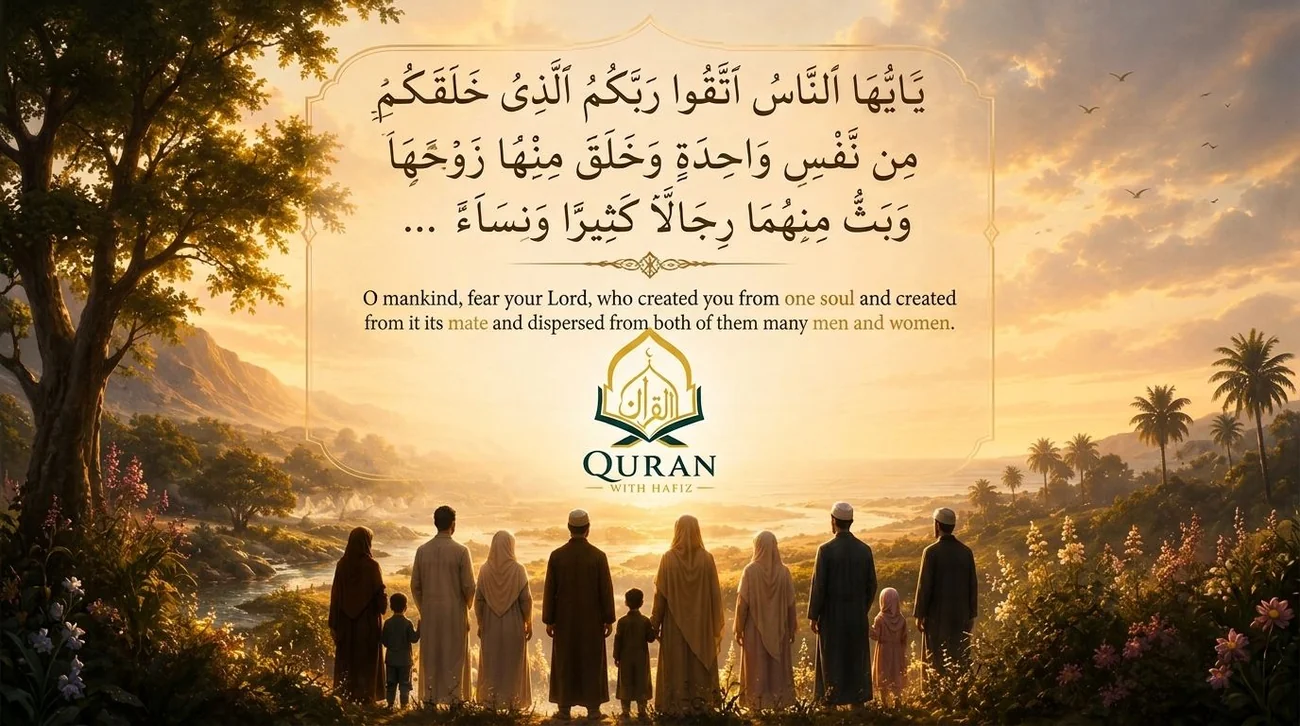
Despite the company of angels, Adam (عَلَيْهِ ٱلسَّلَامُ) experienced a deep loneliness. The angels were immersed in their worship; they could not share in Adam's unique blend of knowledge, emotion, and longing for connection. Recognising this, Allah ﷻ created for Adam a companion — Hawwa, known in English as Eve.
The Quran does not specify the exact mechanism of Hawwa's creation, focusing instead on the relational truth: they came from one source, and from them descended all of humanity. Scholarly opinion on whether she was formed from Adam's rib is diverse — many scholars hold that the famous narration in Sahih Bukhari (3331) uses the rib as a metaphor for a woman's unique nature, not as a description of her literal origin.
The narration advises men to treat women gently — as a metaphor about character, not anatomy. Just as a rib curves naturally and would break if one tried to forcibly straighten it, a woman's unique temperament is not a flaw to be corrected but a quality to be respected. Attempting to reshape it entirely causes harm to the relationship itself.
Paradise & the Forbidden Tree
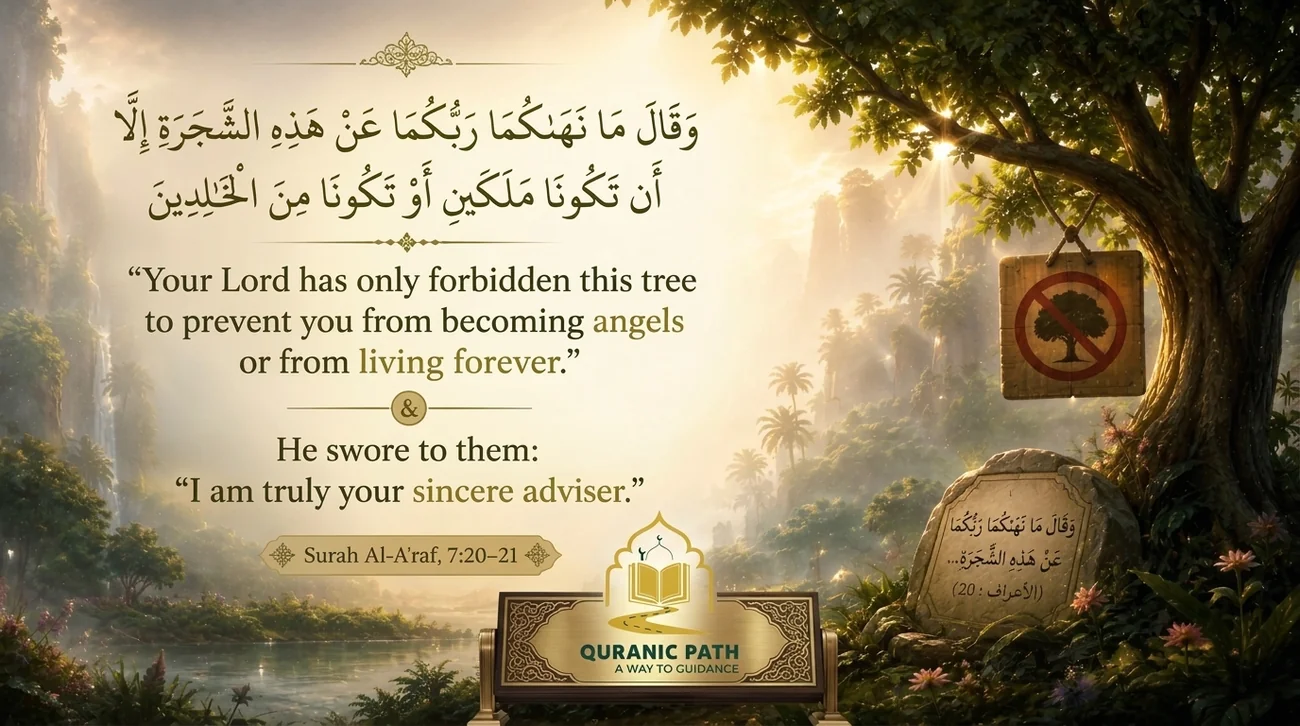
Adam (عَلَيْهِ ٱلسَّلَامُ) and Hawwa were placed in Jannah — Paradise — where they enjoyed complete liberty to eat, explore, and enjoy all it contained. There was, however, one singular prohibition: a specific tree they were commanded not to approach. The Quran does not identify this tree by name or type; its identity matters far less than the divine test it represented.
Iblis, true to his oath, seized this single restriction as his opportunity. He whispered to the couple with patient, persistent suggestion — not open commands, but subtle framing designed to erode trust and inflame desire. He presented the tree as the gateway to immortality and eternal power, even swearing in Allah's name that he was their sincere well-wisher.
The Quran notes: "And We had already taken a covenant from Adam before, but he forgot; and We found not in him determination" (Surah Ta-Ha, 20:115). Human forgetfulness made Adam vulnerable — and Iblis exploited it. When the couple ate from the tree, they immediately became aware of their nakedness and rushed to cover themselves with leaves. The joy of Paradise gave way to shame.
Repentance & Descent to the Earth
Summoned before their Lord, Adam and Hawwa were questioned about their transgression. Allah ﷻ reminded them: "Did I not forbid you from that tree, and tell you that Shaytan is a clear enemy to you?" (Surah Al-A'raf, 7:22). Rather than deflect or deny, they turned immediately and completely to Allah in repentance, speaking words that have become among the most beloved supplications in all of Islamic tradition:
Allah ﷻ accepted their repentance — confirmed in Surah Al-Baqarah (2:37): "Then Adam received from his Lord some words, and He relented towards him." Forgiveness was granted. Yet the divine plan remained: humanity was always destined for Earth, and so Allah decreed the descent of Adam, Hawwa, and Iblis together.
Life on Earth & the First Family
Earth was an entirely different reality from Paradise. Food required effort, shelter had to be built, and wild animals posed real danger. But above all, the greatest trial Adam (عَلَيْهِ ٱلسَّلَامُ) faced was the relentless whispering of Iblis, who kept his oath and never ceased his mission of misguidance. Adam remained resolute — his purpose was to worship Allah and to raise generations who would do the same.
In time, Hawwa bore children — first twins: Qabil (Cain) and his sister; then a second set of twins: Habil (Abel) and his sister. As the children reached adulthood, Allah ﷻ revealed to Adam (عَلَيْهِ ٱلسَّلَامُ) that each son would marry the twin sister of the other — a necessary arrangement, as no other family existed on Earth at that time.

Habil accepted the divine command willingly. Qabil refused — arrogant and self-serving, he objected to the arrangement. Uncertain how to resolve the dispute, Adam (عَلَيْهِ ٱلسَّلَامُ) turned to Allah for guidance. The answer: each son would offer a sacrifice, and Allah would accept the offering of the sincere. Habil offered his finest young animal; Qabil offered the worst of his harvest. The outcome was clear — and it unleashed something devastating.
The First Murder in Human History
Qabil's jealousy grew into violent rage. He confronted Habil with a direct threat: he would kill him. Habil's response stands as one of the most dignified passages in the entire Quran:
Habil chose principle over survival — not from weakness, but from a profound refusal to let fear override his fear of Allah. Despite this, Qabil struck him and took his life: the first act of murder in human history. Adam (عَلَيْهِ ٱلسَّلَامُ) was consumed with grief, having lost both sons on the same day in different ways.
Qabil, having never witnessed death before, wandered confused and overcome with guilt — unsure what to do with his brother's body. Then Allah sent two crows: one killed the other, then dug a hole in the earth, placed the carcass within it, and covered it with soil. Qabil watched, and understood wordlessly.
The Quran follows this account immediately with one of its most frequently cited principles: "Whoever kills a soul — unless for a soul or for corruption in the land — it is as if he has killed all of mankind. And whoever saves one soul, it is as if he has saved all of mankind" (Surah Al-Ma'idah, 5:32). The weight of every human life is declared absolute.
The Death of Prophet Adam (عَلَيْهِ ٱلسَّلَامُ)
Adam (عَلَيْهِ ٱلسَّلَامُ) lived a long life on Earth — some narrations place his lifespan at around one thousand years — fulfilling his role as the first Prophet and father of all of humanity. He continued to warn his descendants about Iblis, taught them to worship Allah alone, and raised generation after generation in consciousness of their Lord and Creator.
As his final days drew near, he expressed a deep longing for the fruits of Paradise. His children set out to find them, only to encounter a company of angels carrying the shroud and burial materials for their father. The angels instructed them to return home. Adam (عَلَيْهِ ٱلسَّلَامُ) passed from this world surrounded by those angels, who washed him, wrapped him in his shroud, offered his funeral prayer, and laid him to rest in the earth — establishing the very rites of Islamic burial for all his descendants after him.
Prophethood then passed to his son Seth (عَلَيْهِ ٱلسَّلَامُ), who continued guiding humanity along the path of Allah's worship. The chain of Prophets — beginning with Adam and ending with Muhammad ﷺ — had been set in motion.
Lessons from the Story of Prophet Adam (AS)
The story of Prophet Adam (عَلَيْهِ ٱلسَّلَامُ) is not merely ancient history — it is a living mirror reflecting every human being's relationship with Allah, with Shaytan, with their own desires, and with the eternal possibility of redemption.
1. Humanity is honoured by Allah. The prostration of the angels before Adam declared the rank Allah bestowed upon mankind — not because of our strength, but because of the knowledge, free will, and spiritual capacity He placed within us.
2. Shaytan is patient and methodical. Iblis did not convince Adam with a single whisper. He persisted — planting seeds of doubt, using half-truths, and appealing to human desire day after day. Recognising this strategy is the first step in guarding against it.
3. Sincere repentance always finds acceptance. Adam and Hawwa sinned — but they returned to Allah immediately, without excuse or deflection. Their repentance was accepted without delay. This is a source of immense, permanent hope for every human being.
4. Arrogance is the root of destruction. Iblis was not destroyed by weakness or ignorance — he was destroyed by pride. His story is a timeless warning to any heart that begins to believe its own opinion matters more than the command of Allah ﷻ.
Learn the stories of the Prophets with Ijazah-certified teachers. Available for students in UK, USA, Canada, and Australia. Kids classes and adult classes available. First 3 classes free.
Bring the Stories of the Prophets to Life
Our certified teachers guide students of all ages through the Quran's narratives, Tajweed, and meaning — one-to-one, online, from anywhere in the world.
View Islamic Studies Course Or book 3 free trial classes — no card requiredFrequently Asked Questions
Common questions about the story of Prophet Adam (AS) — answered from the Quran and Hadith
According to the Quran and Hadith, Prophet Adam (AS) was created from clay gathered from different parts of the Earth. The Prophet Muhammad ﷺ explained that this is why his descendants differ in skin tone, stature, and temperament — reflecting the varied soils from which their forefather was made (Tirmidhi 2955). Allah then breathed His created soul into this clay, bringing Adam to life.
Iblis refused out of arrogance and a belief in his own superiority. He reasoned that fire — the substance from which he was created — was nobler than clay. Allah cast him out for this pride. Iblis was not an angel but a jinn (Surah Al-Kahf, 18:50), which is why he possessed free will and could disobey — something angels cannot do.
Khalifah (خَلِيفَة) means a vicegerent, trustee, or successive authority. When Allah announced to the angels that He would place a Khalifah on Earth (Surah Al-Baqarah, 2:30), He was declaring that humankind would be entrusted with stewardship of the Earth — carrying the responsibility of worship, moral conduct, and propagating righteous generations.
Qabil (Cain) and Habil (Abel) were the sons of Prophet Adam (AS). Each offered a sacrifice to Allah — Habil gave his finest animal; Qabil offered his worst produce. Allah accepted Habil's offering. Qabil, consumed by jealousy, murdered his brother — the first act of killing in human history. A crow then showed Qabil how to bury the body (Surah Al-Ma'idah, 5:31). The Quran follows this story with the principle that killing one soul is like killing all of humanity.
Yes. The Quran explicitly confirms that Allah forgave Adam (AS): "Then Adam received from his Lord some words, and He relented towards him. Indeed, it is He who is the Accepting of Repentance, the Merciful" (Surah Al-Baqarah, 2:37). The descent to Earth was part of the divine plan for humanity — not a permanent punishment. The story teaches that sincere, immediate repentance is always accepted by Allah.