Listen to any experienced Qari reciting the Quran and you will notice a distinctive echoing bounce on certain letters — particularly at the ends of verses and at pauses mid-recitation. This is Qalqalah: one of the most recognisable and most frequently mispronounced rules in all of Tajweed. Students either apply it too weakly (reducing it to a barely audible vibration), apply it incorrectly on the wrong letters, or confuse its three degrees and apply the same strength regardless of position.
This guide fixes all three problems. You will leave understanding exactly which 5 letters trigger Qalqalah, what determines its strength at any given moment, and how to produce each of the 3 degrees correctly in the context of Quran recitation.
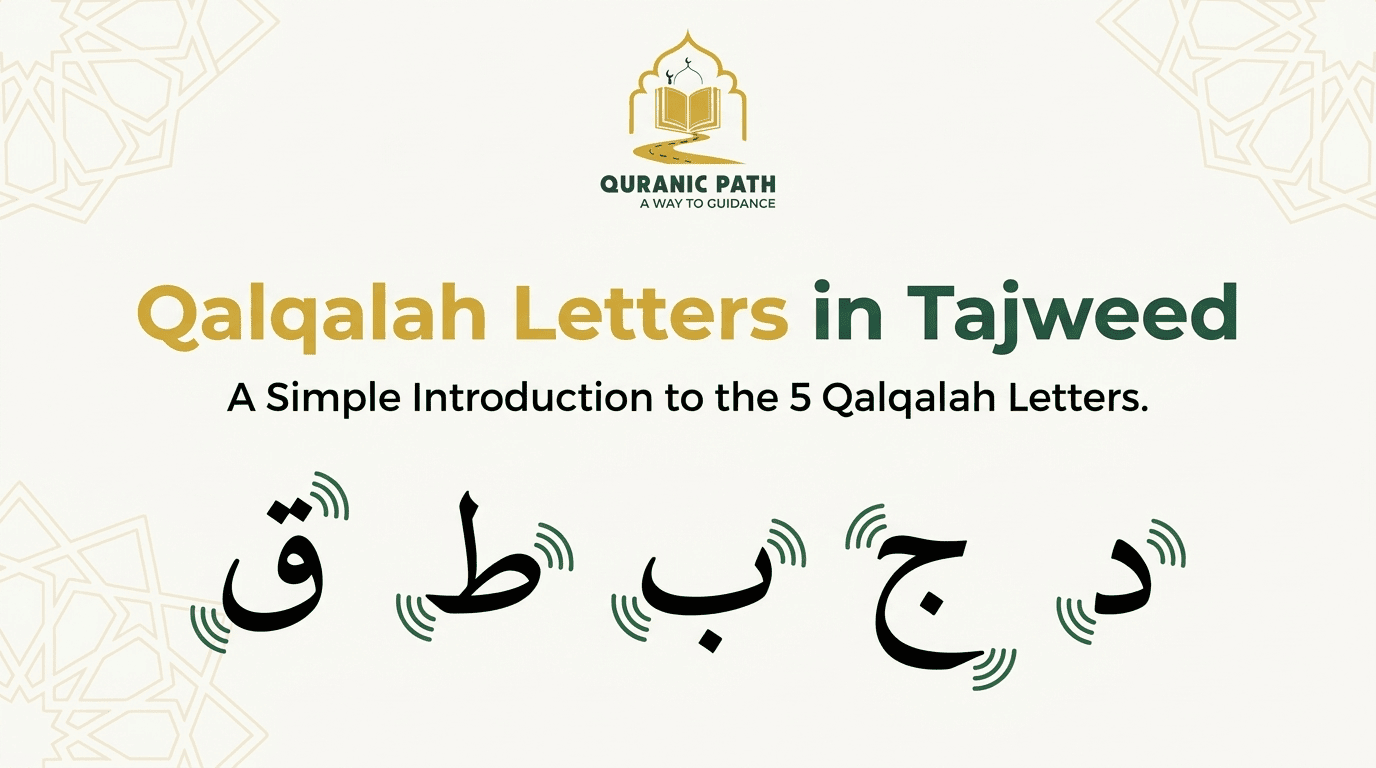
Quick Answer — What is Qalqalah? Qalqalah (قلقلة) is the echoing bounce sound produced when one of the 5 Qalqalah letters (Qaf ق, Ta ط, Ba ب, Jeem ج, Dal د — remembered as قطبجد) carries a Sukoon. There are 3 degrees: Sughra (minor, within a word), Kubra (major, at a word-end pause), and Akbar (greatest, on a doubled letter at a stop). The echo must come from the letter itself — the tongue or lips release pressure after fully stopping the sound, creating a natural resonance.
The 5 Qalqalah Letters — Identification and Memory Aid
Qalqalah applies only to these five letters and to no others. The key condition is that the letter must carry a Sukoon (ْ) — meaning it has no vowel of its own and no vowel immediately follows it in recitation.
| Letter | Name | Type | Why It Produces Echo | Common Error |
|---|---|---|---|---|
| ق | Qaf | Back of tongue, soft palate | Full closure at the very back of the throat — releasing it creates a powerful resonance chamber | Producing a K sound instead, which has less echo |
| ط | Ta (emphatic) | Tongue tip, gum ridge (heavy) | Heavy closure with the tongue in an emphatic position — the release creates a deeper echo than regular Ta | Confusing with regular Ta (ت), which does NOT have Qalqalah |
| ب | Ba | Both lips | Complete lip closure — when the lips release, the resonance escapes outward creating the Qalqalah bounce | Not releasing the lips enough, producing a weak echo |
| ج | Jeem | Middle of tongue, hard palate | Full closure between tongue and palate — release produces a distinctive resonance | Rushing past Jeem without allowing the echo to develop |
| د | Dal | Tongue tip, teeth base | Tongue tip fully stops against the teeth base — the release creates the echo | Confusing with Dhal (ذ) or weakening the stop before release |
The five Qalqalah letters are traditionally remembered using the Arabic phrase قطبجد (Qutb-Jad) or as forming the sounds “q-t-b-j-d.” Notice that all five are stop consonants — letters where the airflow is completely blocked, then released. This full blocking and releasing is precisely why they produce an echo: the sudden release of built-up air resonance creates the Qalqalah bounce. Letters that never fully block airflow (like S, H, or R) cannot produce Qalqalah.
The one condition for Qalqalah: The letter must carry a Sukoon. If the letter has a vowel (Fatha, Kasra, or Damma), no Qalqalah applies — the vowel follows it immediately and no echo can develop. Qalqalah only occurs when the letter is silent (consonant only, with no following vowel sound).
The 3 Degrees of Qalqalah — Full Explanation with Examples
The strength of Qalqalah is not fixed — it varies based on the letter’s position in the word and whether you are stopping there or continuing. Three degrees exist, from weakest to strongest:
Qalqalah Sughra — قلقلة صغرى (Minor)
When it applies: The Qalqalah letter carries a Sukoon and appears in the middle of a word — recitation continues after it without stopping.
Echo strength: Brief and light — approximately 1 count. The echo is present but controlled, not disrupting the flow of the recitation into the next letter.
Quranic examples:
Qalqalah Kubra — قلقلة كبرى (Major)
When it applies: The Qalqalah letter appears at the end of a word and you stop or pause on it. When the letter ends a word but recitation continues immediately into the next word, Sughra applies — not Kubra.
Echo strength: Clear and audible — approximately 2 counts. Significantly stronger than Sughra. The silence after the echo must be held briefly to let it resonate.
Quranic examples:
Qalqalah Akbar — قلقلة أكبر (Greatest)
When it applies: The Qalqalah letter carries a Shaddah (ّ) and you stop on it. The Shaddah doubles the letter, and when you stop on a doubled Qalqalah letter, the echo is at maximum strength.
Echo strength: Full and powerful — 2 to 3 counts. The strongest possible Qalqalah — the letter must completely release to allow the full resonance to develop.
Quranic examples:
Get Your Qalqalah Corrected Live by a Certified Teacher
Qalqalah degree and strength must be heard and corrected in real time — it is very difficult to self-assess. Book 3 free trial classes with an Ijazah-certified Tajweed teacher.
Book 3 Free Trial ClassesIjazah-certified teachers · UK, USA, Canada & Australia · No card requiredHow to Produce Qalqalah Correctly — The Physical Method
Understanding Qalqalah theoretically and producing it correctly in recitation are two different skills. Here is the exact physical method:
- Step 1 — Complete the letter’s stop: For each Qalqalah letter, fully form the consonant sound — the lips close completely for Ba, the tongue tip fully presses for Dal, the throat fully closes for Qaf. Do not rush.
- Step 2 — Hold the stop briefly: Hold the closed position for approximately half a count before releasing. This is the compression that creates the echo when released.
- Step 3 — Release cleanly and completely: Release the closure completely — lips fully apart for Ba, tongue fully away from the teeth for Dal. The release must be clean and sudden, not gradual. A gradual release produces a weak, muddy echo rather than a clean Qalqalah bounce.
- Step 4 — Let the resonance develop: Do not immediately continue to the next letter. Allow the echo to resonate for the appropriate number of counts based on the degree. The silence after the release is part of the Qalqalah — it is not a gap or error.
Never add a vowel after the Qalqalah letter. The most common error is producing a faint “a” or “u” sound after the letter — making Dal sound like “dah” or “duh”, or Ba sound like “bah”. This is not Qalqalah — it is incorrect recitation. The echo must be a resonance of the letter itself, not a vowel sound added after it.
Most Common Qalqalah Mistakes
Applying Qalqalah to the Wrong Letters
Regular Ta (ت) does NOT have Qalqalah — only emphatic Ta (ط) does. Regular Da letters like Dhal (ذ) and Dhad (ض) do NOT have Qalqalah — only Dal (د) does. Students frequently apply Qalqalah to similar-looking letters. The 5 letters are fixed: قطبجد. Nothing else.
Applying the Same Strength Regardless of Degree
Many students apply Kubra-strength Qalqalah everywhere — a very strong echo even for mid-word Sughra positions. This makes recitation sound jerky and unnatural. Sughra should be subtle; Kubra should be audible; Akbar should be strong. The difference matters and must be practised deliberately.
Adding a Vowel Sound After the Letter (Not Real Qalqalah)
Adding “ah”, “uh”, or any vowel sound after the letter is not Qalqalah — it is an error that changes the word. The echo is a resonance of the consonant itself, produced by releasing the stop cleanly. The mouth shape after the release should be neutral, not shaped for a vowel.
Applying Kubra When Not Actually Stopping
Qalqalah Kubra only applies when you stop on the end-of-word letter. If you are reciting continuously and the Qalqalah letter ends one word and the next word immediately follows, Sughra applies — not Kubra. Students who always apply Kubra at word-end letters regardless of stopping are applying the rule incorrectly.
Practising Qalqalah — Which Surahs to Use
The three Quls (Al-Ikhlas, Al-Falaq, An-Nas) contain examples of all three Qalqalah degrees within just 17 short verses — making them the ideal practice ground:
- Surah Al-Ikhlas (112): Ahad (أَحَدْ) — Dal Sukoon, Kubra when stopping. Al-Samad (الصَّمَدْ) — Dal Sukoon, Kubra. Yalid (يَلِدْ) — Dal Sukoon, Kubra. Three clear Kubra examples in four short verses.
- Surah Al-Falaq (113): Al-Falaq (الْفَلَقْ) — Qaf Sukoon, Kubra when stopping. Excellent for practising Qaf Qalqalah.
- Surah An-Nas (114): Al-Khannas (الْخَنَّاسِ) — includes letters nearby Qalqalah but also has an-Nas itself ending in Seen, not a Qalqalah letter. Useful for practising identifying which letters do NOT trigger Qalqalah.
- Surah Al-Masad (111): Tabbat (تَبَّتْ) — doubled Ba with Shaddah, strong Akbar example. Al-Lahab (الْلَهَبْ) — Ba Sukoon, Kubra when stopping.
Frequently Asked Questions
Qalqalah (قلقلة) means to echo or bounce. In Tajweed, it is the vibrating echo produced when one of the 5 Qalqalah letters (قطبجد) carries a Sukoon. The echo comes from the letter itself — the tongue or lips fully stop the sound then release cleanly, creating a natural resonance. It is one of the most distinctive sounds in beautiful Quran recitation.
The 5 Qalqalah letters are: Qaf (ق), Ta emphatic (ط), Ba (ب), Jeem (ج), Dal (د) — remembered as قطبجد. All five are stop consonants where airflow is completely blocked then released, creating the natural conditions for an echo. Qalqalah applies when any of these letters carries a Sukoon.
Qalqalah Sughra (minor): Letter with Sukoon mid-word, recitation continues. Brief echo — ~1 count. Qalqalah Kubra (major): Letter at end of word where you stop or pause. Clear echo — ~2 counts. Qalqalah Akbar (greatest): Letter doubled with Shaddah at a stopping point. Strongest echo — 2–3 counts.
Surah Al-Ikhlas (112) has three Kubra Qalqalah examples in just four verses — making it the most Qalqalah-dense short Surah. Surah Al-Falaq has prominent Qaf Qalqalah. Surah Al-Masad has Ba Shaddah Akbar examples. The three Quls together cover all three degrees and are the ideal practice surahs for Qalqalah.
No — only emphatic Ta (ط) has Qalqalah. Regular Ta (ت) does not. This is one of the most common Qalqalah errors — applying Qalqalah to regular Ta when reading. The 5 Qalqalah letters are fixed: قطبجد. Every other letter, including regular Ta, Dal‑like letters, and all others, does not trigger Qalqalah regardless of whether they carry a Sukoon.
Qalqalah — The Sound That Makes Recitation Come Alive
Correct Qalqalah transforms recitation. It is one of the most audibly obvious differences between a reciter who has studied Tajweed properly and one who has not — experienced listeners notice its presence immediately. Once you know the 5 letters, understand the 3 degrees, and learn to release each consonant cleanly without adding a vowel, Qalqalah becomes automatic within weeks of consistent practice.
Start with the three Quls. Practise stopping on each verse-end letter and listening for the echo in your own recitation. Bring recordings of your practice to your teacher for correction. Within a month, your Qalqalah will be clearly audible — and your recitation will sound measurably more beautiful for it.
Learn Quran Online With an Ijazah-Certified Teacher
One-to-one online classes covering Noorani Qaida, Tajweed, Hifz, Arabic and Islamic Studies. All ages, all timezones. First 3 trial classes completely free — no card, no commitment.
View All CoursesOr book 3 free trial classes — no card required