Of all the obligations in Islam, none is more central, more repeated, or more transformative than Salah. The Prophet Muhammad ﷺ described it as "the pillar of religion" — without it, everything else collapses. Performed five times every day, Salah is not simply a religious requirement; it is a recurring reset — a moment of standing before Allah, acknowledging His greatness, and returning to the purpose of your existence.
For a new Muslim, or for a Muslim who has grown up in a non-practising household, learning to pray correctly can feel daunting. The Arabic recitations, the specific positions, the rules of Wudu, the different Raka'at for each prayer — it seems like a lot at once. This guide removes all of that overwhelm. Every element is explained step by step, in plain English, with the Arabic text, transliteration, and translation provided for every recitation.
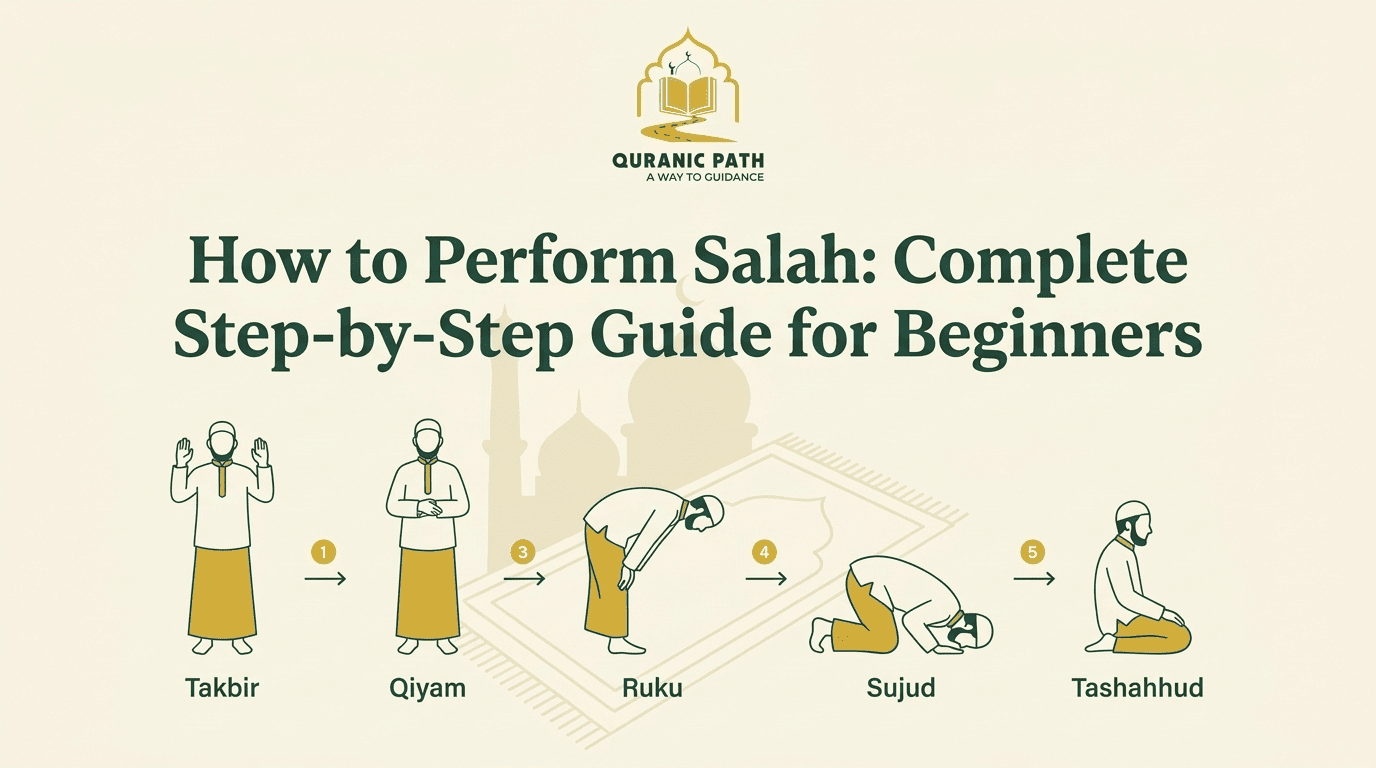
Quick Answer — How to Perform Salah: Make Wudu (ritual purification), face the Qibla (direction of Mecca), make your intention (Niyyah), say the opening Takbir (Allahu Akbar), recite Al-Fatiha standing, bow in Ruku, prostrate twice in Sujud, sit for Tashahhud, and end with Tasleem (As-salamu alaykum). This completes one Raka'ah (unit). Repeat for the required number of Raka'at for each of the five daily prayers.
What is Salah and Why is it Obligatory?
Salah (صلاة) — also known as Salat, Namaz, or simply "prayer" — is the formal act of worship performed by Muslims five times daily. It is the second of the Five Pillars of Islam and is obligatory (Fardh) upon every adult Muslim who has reached puberty, is sane, and is not in a state that excuses them (such as certain conditions of illness or travel).
The obligation of Salah was commanded directly by Allah during the Night Journey (Isra wal Mi'raj) of the Prophet Muhammad ﷺ — the only pillar of Islam revealed not through the Angel Jibreel on earth, but through direct encounter in the heavens. It was originally prescribed as fifty prayers daily, reduced through the intercession of the Prophet ﷺ to five — with the reward of fifty preserved.
إِنَّ الصَّلَاةَ كَانَتْ عَلَى الْمُؤْمِنِينَ كِتَابًا مَّوْقُوتًا — "Indeed, prayer has been decreed upon the believers a decree of specified times."
Surah An-Nisa (4:103)The Prophet ﷺ said: "The first thing a person will be asked about on the Day of Judgement is their Salah. If it is sound, all their deeds will be sound. If it is deficient, all their deeds will be deficient." (Tabarani). This hadith captures why Salah is described as the pillar upon which all other acts of worship rest — its regular performance shapes the character, disciplines the soul, and maintains the Muslim's connection with Allah throughout every day.
Before You Pray — The Prerequisites of Salah
Salah has specific prerequisites that must be fulfilled before the prayer is valid. Praying without meeting these prerequisites means the Salah is not accepted. There are five main prerequisites:
Islam — Being a Muslim
Salah is an act of worship specific to Muslims. The prayer of a non-Muslim is not valid. If someone accepts Islam (takes the Shahada), their obligation to pray begins immediately from that moment.
Sanity and Awareness
The person must be of sound mind. Someone who is unconscious, severely mentally ill, or in a state of temporary loss of awareness is not obligated to pray and does not make up missed prayers in most cases. When awareness returns, the obligation resumes.
Taharah — Ritual Purity
The person must be in a state of Wudu (minor purification) or Ghusl (major purification, if required). The clothing must be free from Najasah (ritual impurity). The prayer space must be clean. Without Taharah, Salah is not valid. Wudu is covered in full detail in the next section.
Covering the Awrah
The Awrah (the parts of the body that must be covered) must be covered during Salah. For men: from the navel to the knee. For women: the entire body except the face and hands, according to the majority of scholars. Praying in insufficient clothing invalidates the Salah if coverage was available.
Facing the Qibla
The person must face the Qibla — the direction of the Kaaba in Mecca — during Salah. The only exceptions are during voluntary (Nafl) prayer while travelling, during extreme fear (when facing the Qibla is impossible), and for someone who is unable to move. How to find the Qibla is explained in detail below.
How to Perform Wudu (Ritual Purification) — Step by Step
Wudu (وضوء) is the ritual washing performed before Salah (and before touching the Quran). It purifies the body and prepares the Muslim spiritually and physically for standing before Allah. The steps of Wudu were taught directly by the Prophet Muhammad ﷺ and have been transmitted in this form ever since.
Wudu Quick Summary: Intention → Wash hands × 3 → Rinse mouth × 3 → Rinse nose × 3 → Wash face × 3 → Wash arms to elbows × 3 (right then left) → Wipe head once → Wipe ears once → Wash feet to ankles × 3 (right then left). Begin with Bismillah and the intention in your heart.
Complete Wudu — Every Step in Detail
| Step | Action | Times | Notes |
|---|---|---|---|
| 1 | Make Niyyah (intention) and say Bismillah | Once | Silent intention in the heart; Bismillah spoken aloud |
| 2 | Wash both hands up to and including the wrists | 3× | Ensure water reaches between the fingers |
| 3 | Rinse the mouth (Madmadah) — swish water around the mouth | 3× | Spit the water out each time; use right hand to bring water |
| 4 | Rinse the nose (Istinshaq) — sniff water in and blow it out | 3× | Use right hand to bring water, left hand to blow out |
| 5 | Wash the entire face from forehead hairline to chin, ear to ear | 3× | Include the visible parts of the beard; ensure all skin is wet |
| 6 | Wash right arm from fingertips to elbow (inclusive) | 3× | Always right before left |
| 7 | Wash left arm from fingertips to elbow (inclusive) | 3× | Ensure water reaches elbow crease |
| 8 | Wipe the entire head once with wet hands (Mash) | 1× | Both hands run from forehead to back of head and return; only once |
| 9 | Wipe both ears — inside with index fingers, outside with thumbs | 1× | Using the remaining wetness from the head wipe |
| 10 | Wash right foot from toes to ankle (inclusive) | 3× | Ensure water reaches between the toes |
| 11 | Wash left foot from toes to ankle (inclusive) | 3× | Always right before left |
| 12 | Say the Wudu completion du'a | Once | Ashhadu an la ilaha illallah wa ashhadu anna Muhammadan abduhu wa rasuluh |
What Invalidates Wudu
- Using the toilet — both urination and defecation invalidate Wudu completely
- Passing wind — even without sound or smell, this invalidates Wudu
- Deep sleep — sleeping lying down or in a position where the body is fully relaxed invalidates Wudu; brief dozing while sitting (according to many scholars) does not
- Loss of consciousness — fainting, anaesthesia, or similar states
- Bleeding — according to the Hanafi school, significant bleeding from anywhere invalidates Wudu; the Shafi'i and Maliki schools hold that bleeding does not invalidate Wudu
- Touching private parts — according to the Shafi'i school; the Hanafi school does not consider this invalidating
When Wudu is not available — Tayammum: If clean water is not available (during travel, illness, or certain emergency situations), a Muslim may perform Tayammum — the dry purification using clean earth or dust. Strike clean earth or a dusty surface with both palms, wipe the face once, then wipe each arm once. This is a valid substitute for Wudu and Ghusl when water is genuinely unavailable or its use would cause harm.
Finding the Qibla — Direction of Prayer
The Qibla (قبلة) is the direction of the Kaaba in Mecca, Saudi Arabia — the direction every Muslim faces during Salah. Allah commands in the Quran: "Turn your face toward Al-Masjid Al-Haram. And wherever you are, turn your faces toward it." (Surah Al-Baqarah, 2:144).
Qibla Direction by Country
| Location | Qibla Direction | Approximate Compass Bearing |
|---|---|---|
| 🇬🇧 United Kingdom (London) | Southeast | ~119° |
| 🇺🇸 USA (New York) | Northeast | ~58° |
| 🇨🇦 Canada (Toronto) | Northeast | ~54° |
| 🇦🇺 Australia (Sydney) | Northwest | ~277° |
| 🇦🇪 UAE (Dubai) | West-Northwest | ~281° |
| 🇸🇦 Saudi Arabia (Riyadh) | West-Northwest | ~287° |
| 🇵🇰 Pakistan (Karachi) | West-Northwest | ~274° |
How to find your exact Qibla: Use the Muslim Pro or Qibla Finder app on your smartphone — both use GPS to give your precise Qibla direction. Alternatively, most mosques have the Qibla marked on their wall or carpet. At home, once you have found your Qibla direction, place a small mark on the wall or floor so you do not need to search each time.
The Five Daily Prayers — Times and Raka'at
The five daily prayers each have a specific time window within which they must be performed. Missing a prayer time without a valid reason is a sin — if a prayer is missed, it must be made up as soon as possible.
| Prayer | Arabic | Time | Fardh Raka'at | Sunnah Raka'at |
|---|---|---|---|---|
| Fajr | الفجر | True dawn until just before sunrise | 2 | 2 Sunnah before (Muakkadah) |
| Dhuhr | الظهر | After midday until shadow = object height | 4 | 4 before + 2 after (Muakkadah) |
| Asr | العصر | End of Dhuhr time until sunset | 4 | 4 before (Sunnah Ghair Muakkadah) |
| Maghrib | المغرب | Just after sunset until twilight disappears | 3 | 2 Sunnah after (Muakkadah) |
| Isha | العشاء | After twilight until midnight (preferred) | 4 | 2 Sunnah after + 3 Witr (Wajib) |
Prayer time apps: Prayer times vary significantly by location and season — especially in the UK, Canada, and Australia where summer and winter daylight hours differ dramatically. Use a reliable app like Muslim Pro, Athan, or Salah Time set to your specific location. Many mosques also publish monthly prayer timetables for their local area.
How to Perform Salah — Complete Step-by-Step Guide
The following guide describes how to perform a complete Raka'ah (unit) of Salah. Most prayers consist of 2, 3, or 4 Raka'at — the sitting positions (Tashahhud) differ depending on the total number. This is explained clearly after the individual step descriptions.
Step 1 — Niyyah: The Intention
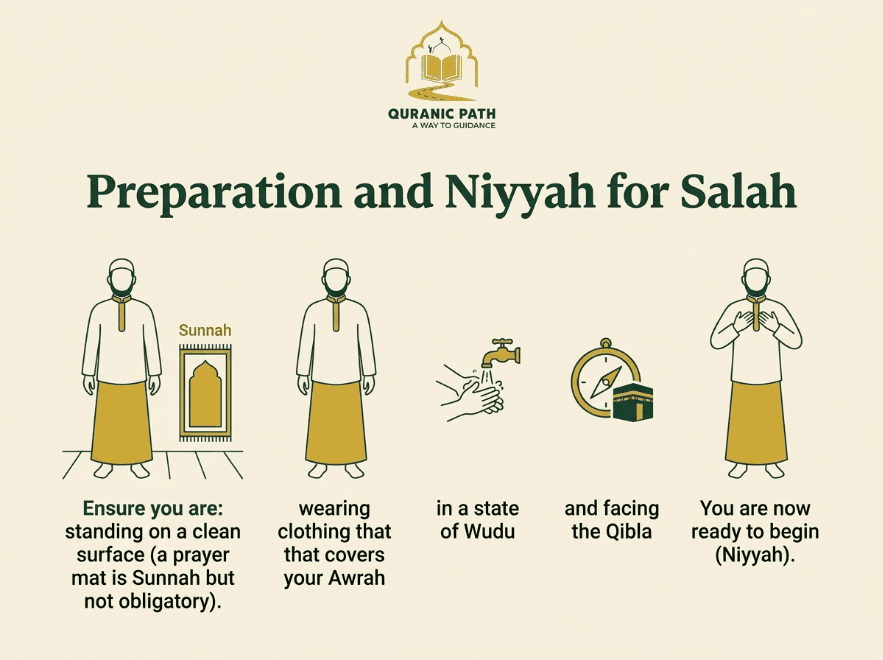
Before beginning Salah, make a silent intention in your heart specifying which prayer you are performing. You do not need to say the intention aloud — according to the majority of scholars, the intention is made in the heart, not the tongue. For example: "I intend to pray two Raka'at of Fajr for the sake of Allah, facing the Qibla."
Ensure you are: standing on a clean surface (a prayer mat is Sunnah but not obligatory), wearing clothing that covers your Awrah, in a state of Wudu, and facing the Qibla. You are now ready to begin.
Image: Niyyah — The Intention
Step 2 — Takbiratul Ihram: The Opening Statement
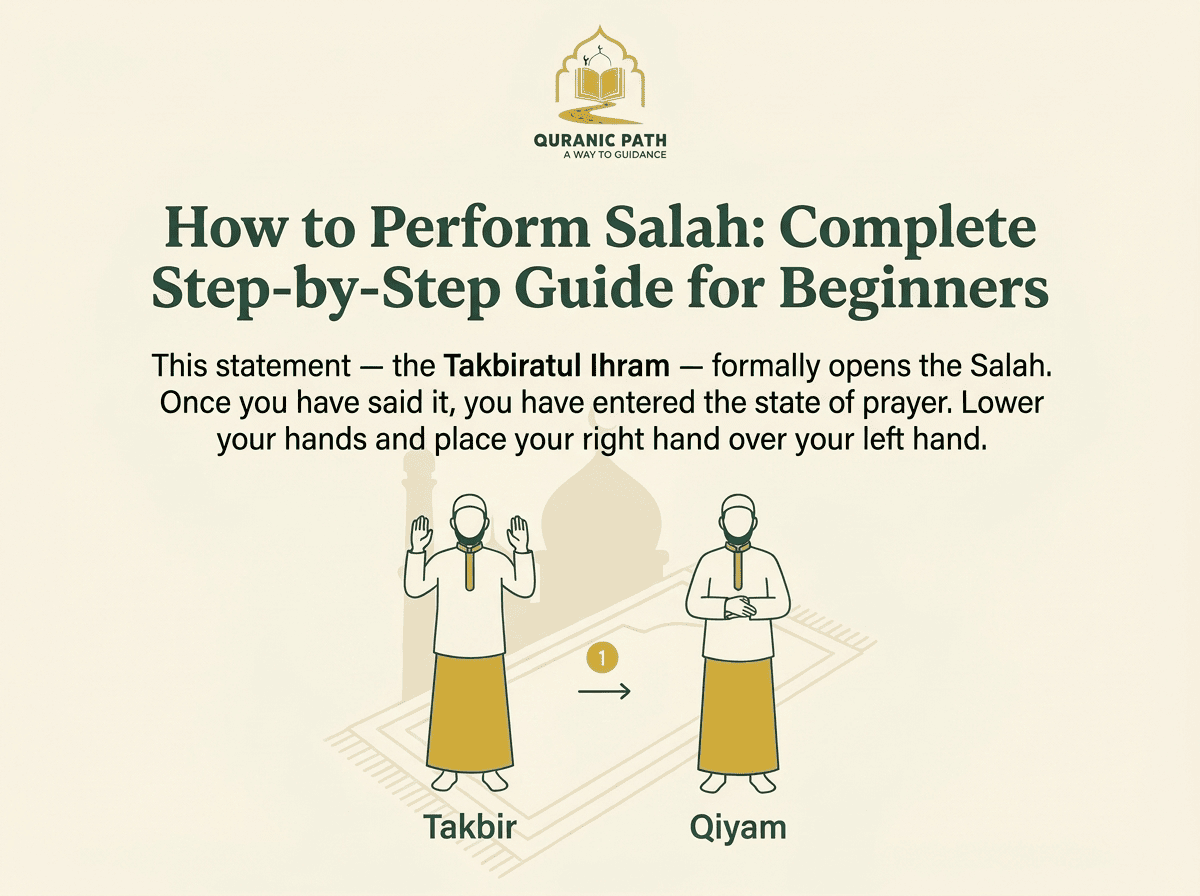
Raise both hands to the level of your earlobes, with palms facing forward, and say:
This statement — the Takbiratul Ihram — formally opens the Salah. Once you have said it, you have entered the state of prayer. Lower your hands and place your right hand over your left hand on your chest (some schools place hands below the navel — both are valid).
Image: Takbir-e-Tahrimah — The Opening Statement
Step 3 — Qiyam: Standing and Reciting
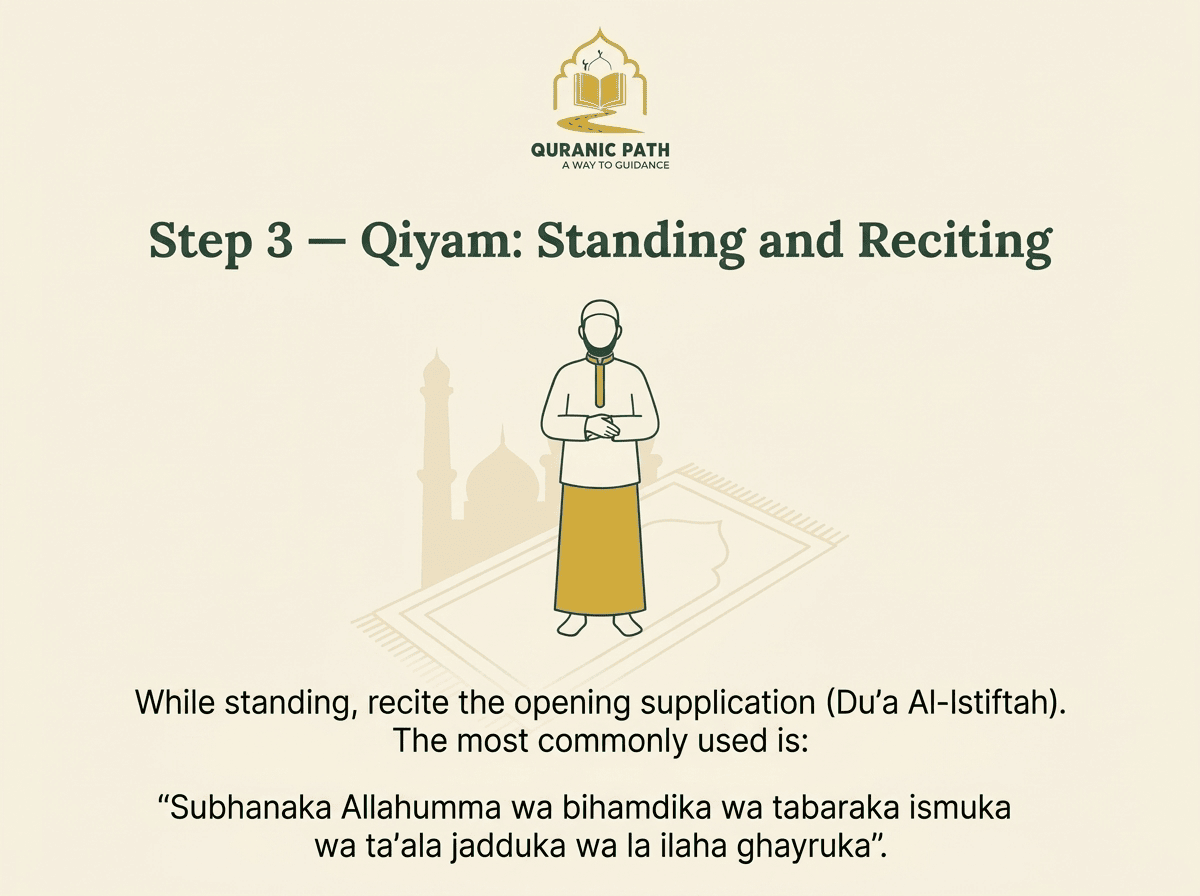
While standing, recite the opening supplication (Du'a Al-Istiftah). The most commonly used is:
Image: Qiyam — Standing in Salah
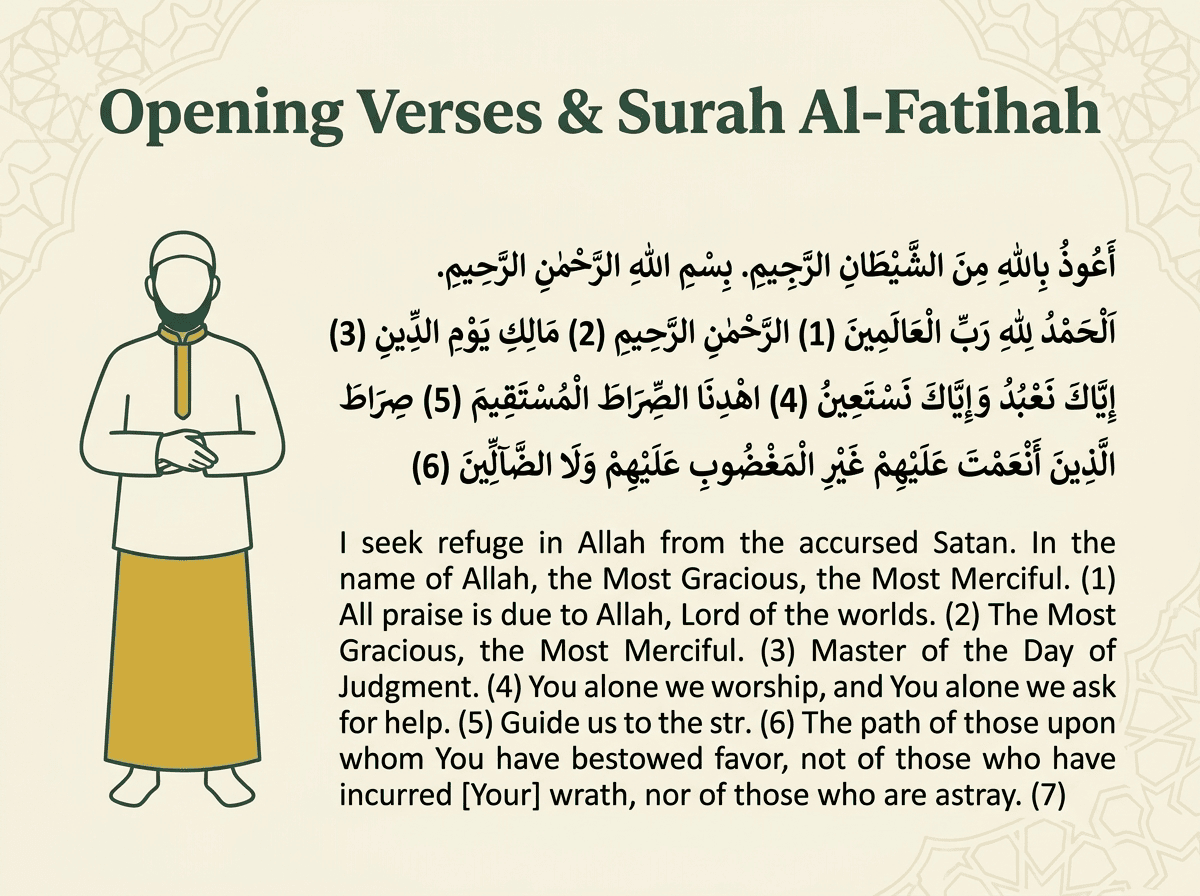
Then say: A'udhu billahi min ash-shaytanir rajim (I seek refuge in Allah from the accursed Shaytan), followed by Bismillahir rahmanir rahim, then recite Surah Al-Fatiha:
Image: Recitation of Surah Al-Fatihah
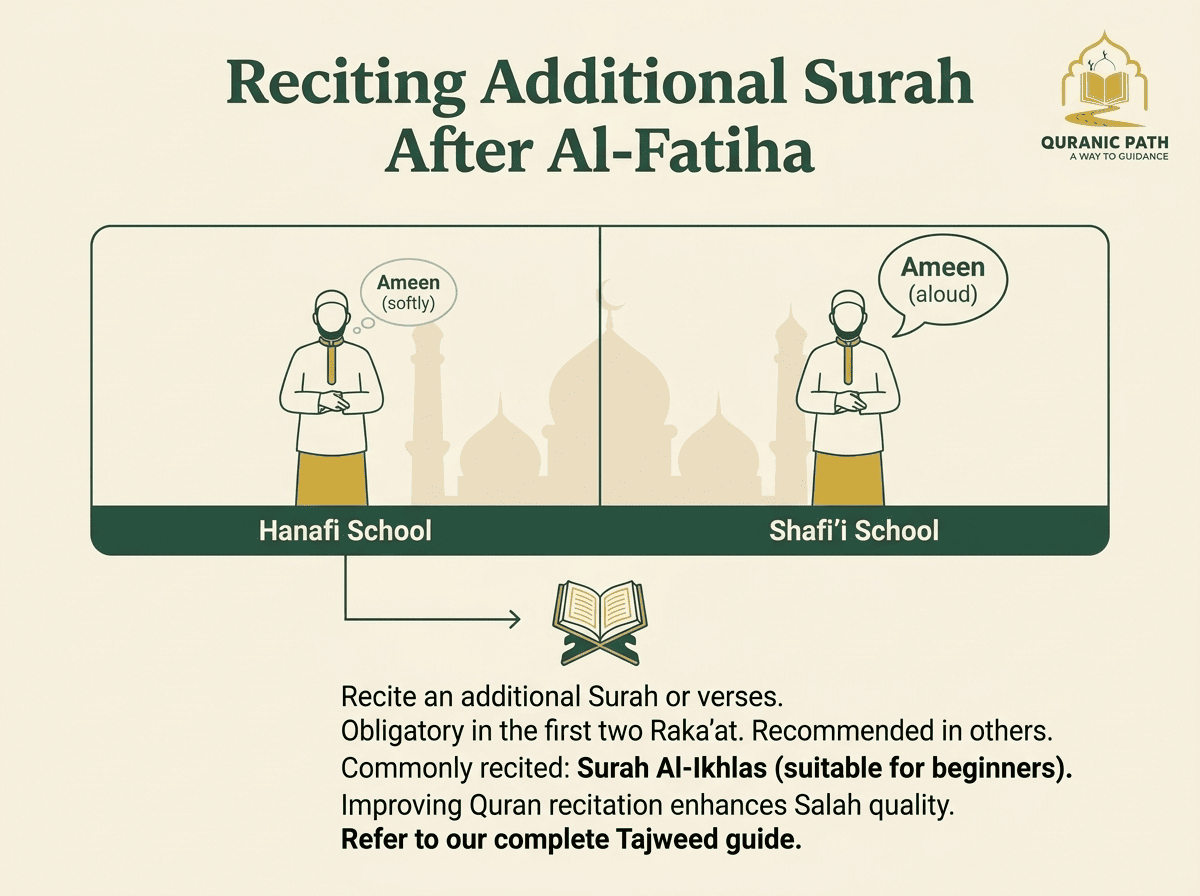
After Al-Fatiha, say Ameen (softly in congregational prayer, according to the Hanafi school; aloud according to the Shafi'i school). Then recite any additional Surah or verses from the Quran. This is obligatory in the first two Raka'at and recommended in others. Surah Al-Ikhlas is commonly recited and is suitable for beginners to memorise first. Improving Quran recitation is directly connected to the quality of Salah — see our complete Tajweed guide to refine your recitation.
Image: Additional Surah
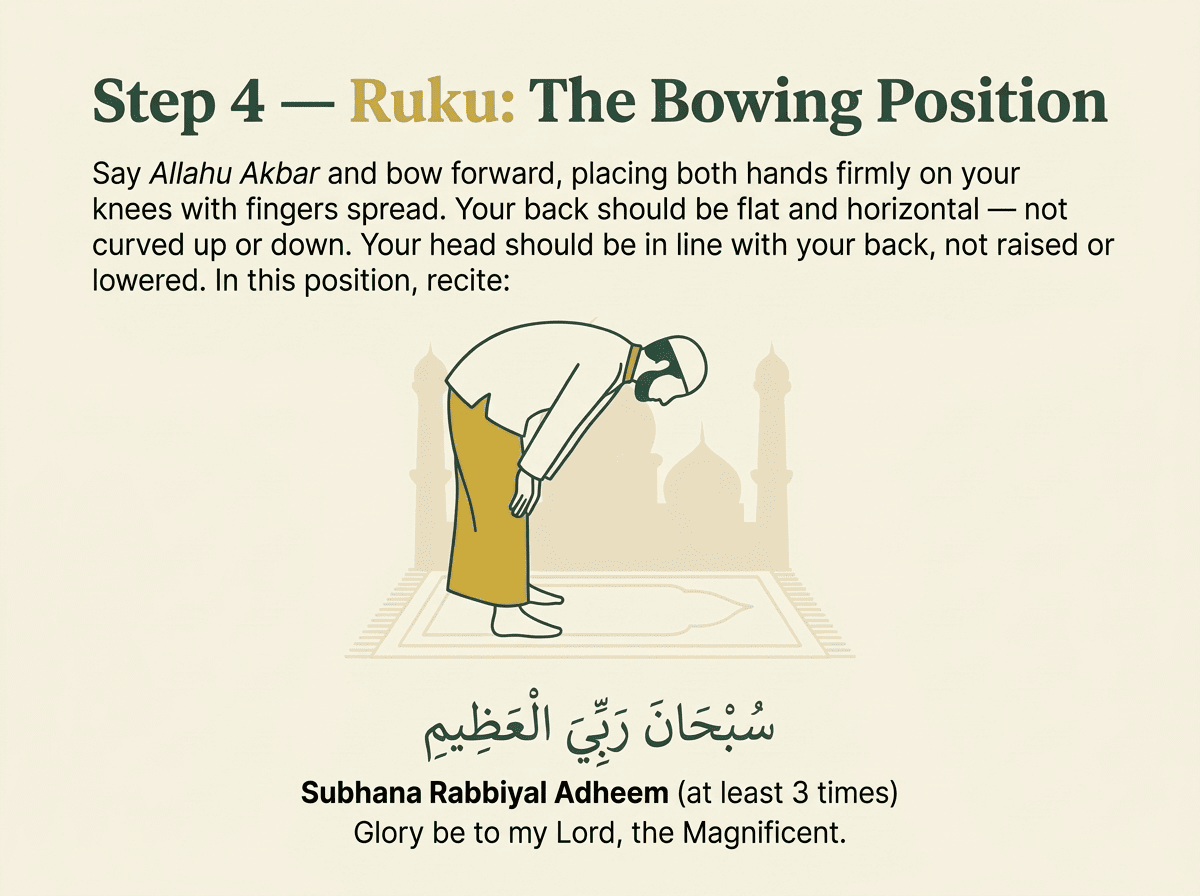
Step 4 — Ruku: The Bowing Position
Say Allahu Akbar and bow forward, placing both hands firmly on your knees with fingers spread. Your back should be flat and horizontal — not curved up or down. Your head should be in line with your back, not raised or lowered. In this position, recite:
Image: Ruku — Bowing in Salah
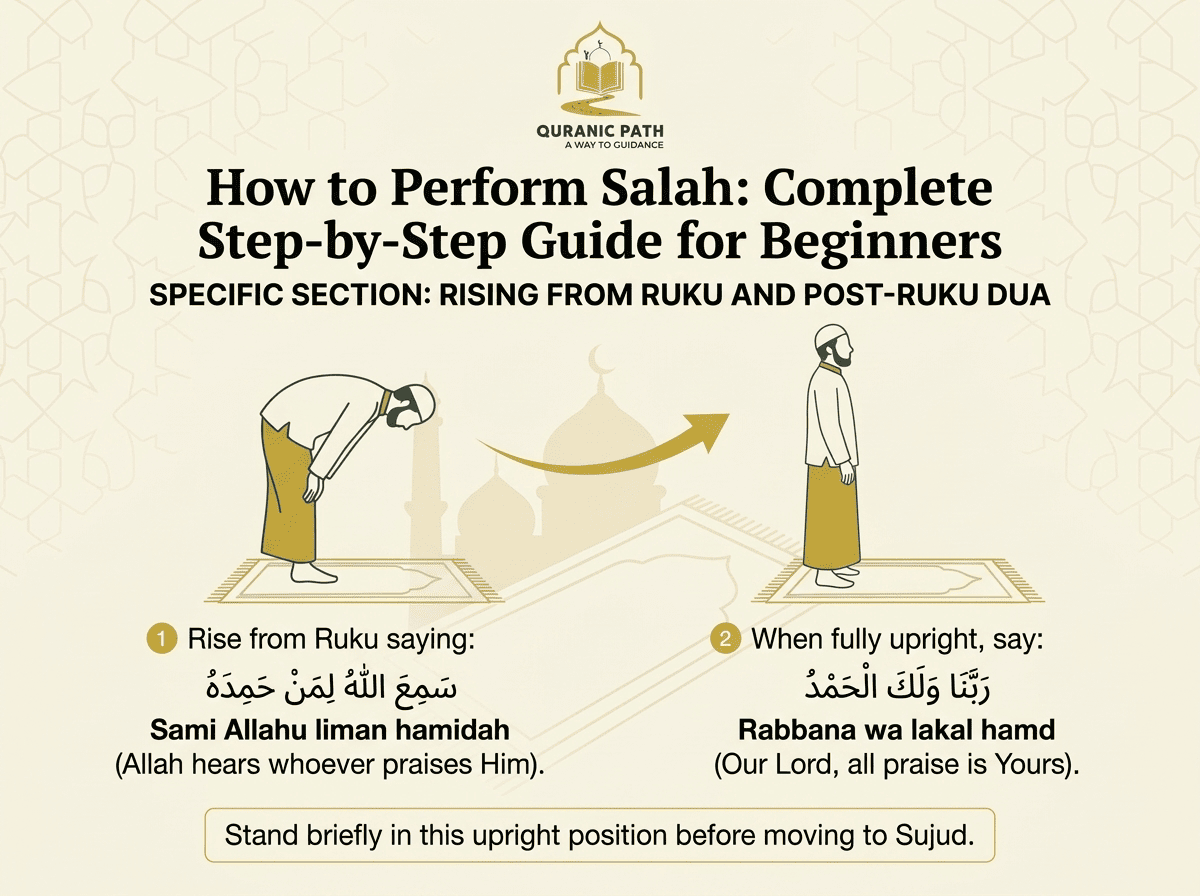
Rise from Ruku saying: Sami Allahu liman hamidah (Allah hears whoever praises Him). When fully upright, say: Rabbana wa lakal hamd (Our Lord, all praise is Yours). Stand briefly in this upright position before moving to Sujud.
Image: Qawmah — Standing after Ruku
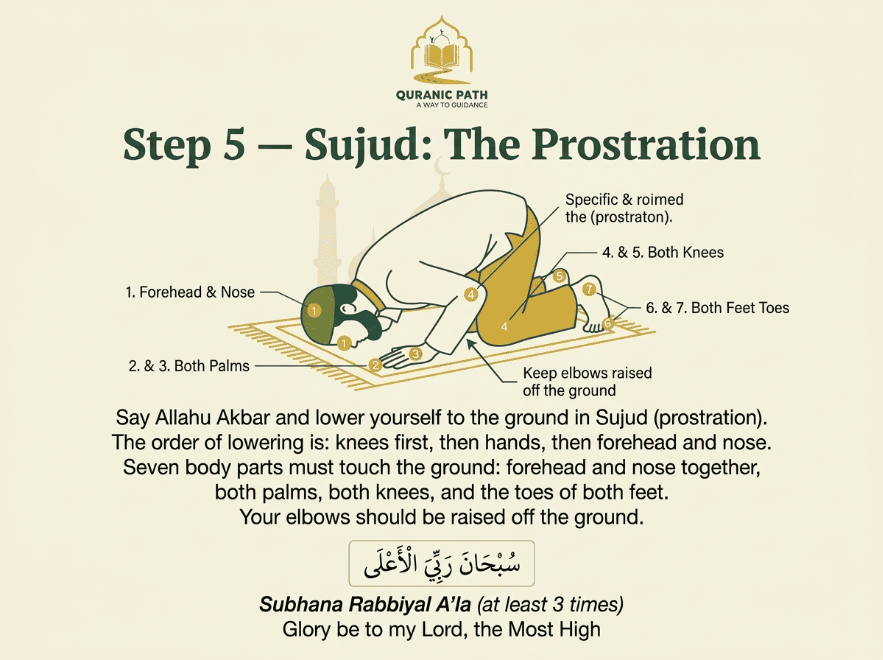
Step 5 — Sujud: The Prostration
Say Allahu Akbar and lower yourself to the ground in Sujud (prostration). The order of lowering is: knees first, then hands, then forehead and nose. Seven body parts must touch the ground: forehead and nose together, both palms, both knees, and the toes of both feet. Your elbows should be raised off the ground. In this position, recite:
Image: First Sajdah
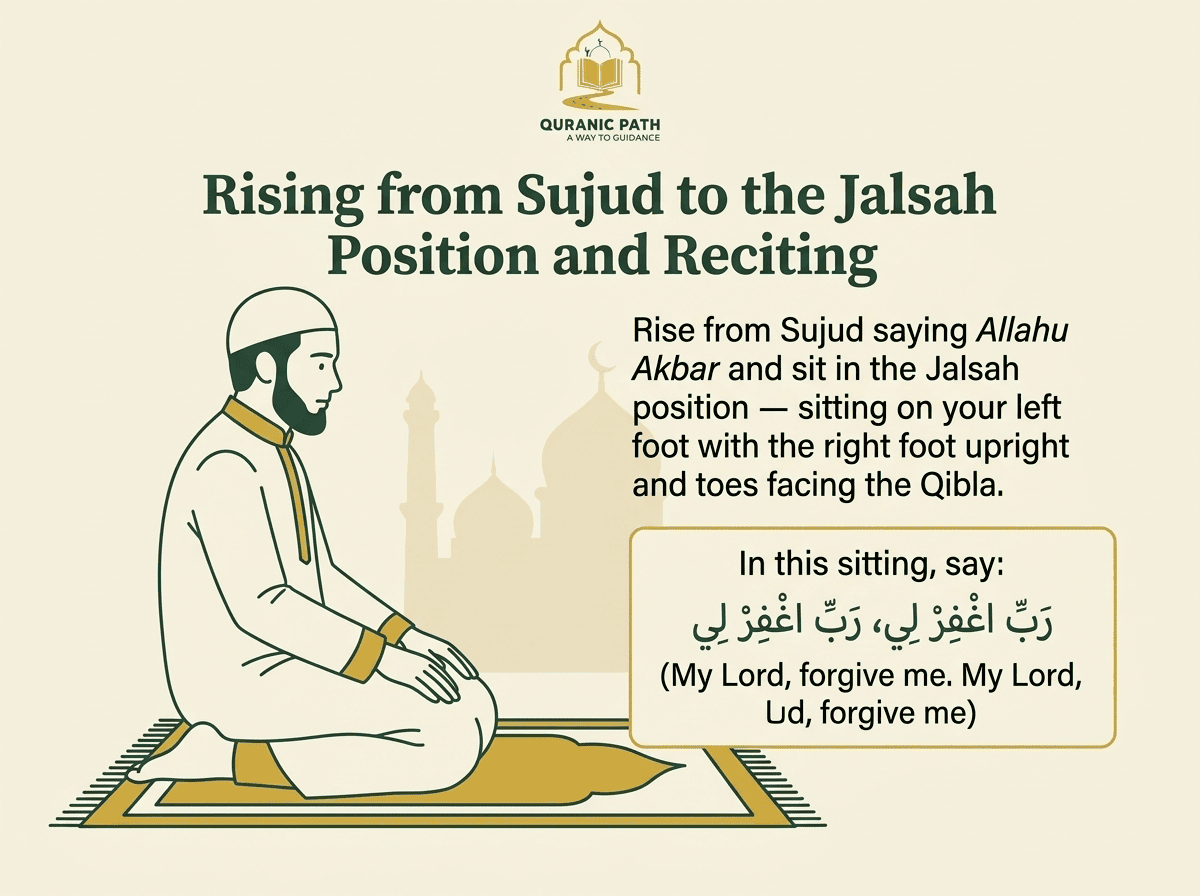
Rise from Sujud saying Allahu Akbar and sit in the Jalsah position — sitting on your left foot with the right foot upright and toes facing the Qibla. In this sitting position between the two prostrations, say: Rabbighfir li, Rabbighfir li (My Lord, forgive me. My Lord, forgive me).
Image: Sitting between the Two Sajdahs (Jalsah)
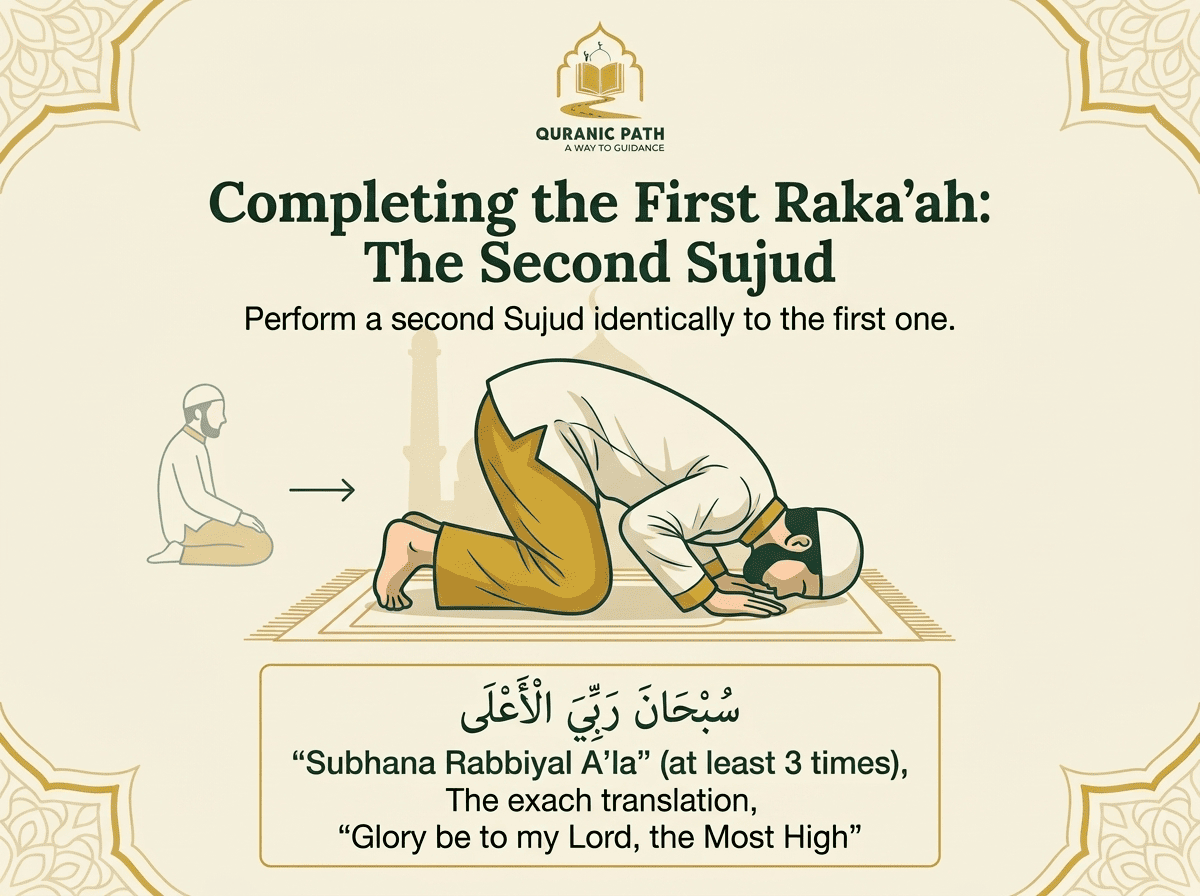
Then perform a second Sujud identically — this completes one Raka'ah.
Image: Second Sajdah
The spiritual significance of Sujud: The Prophet ﷺ said: "The closest a servant is to his Lord is when he is in Sujud — so make much du'a in it." (Muslim). The prostration is the most intimate moment of Salah — when the highest part of the human body, the forehead, is placed on the ground in complete humility before the Creator. Use this moment for sincere personal supplication in addition to the obligatory recitations.
Standing for the Second Rak'ah
After completing the first Raka'ah — Qiyam, Ruku, Qawmah, and both Sajdahs — rise from the second Sajdah saying Allahu Akbar and stand up straight for the second Raka'ah. Fold your hands again as at the start and repeat the same sequence: recite Al-Fatiha, an additional Surah, then Ruku and the two Sajdahs once more. Notably, the opening Du'a Al-Istiftah is not repeated in the second Raka'ah — it is only said once, at the very beginning of the prayer.
Image: Standing for the Second Rak'ah
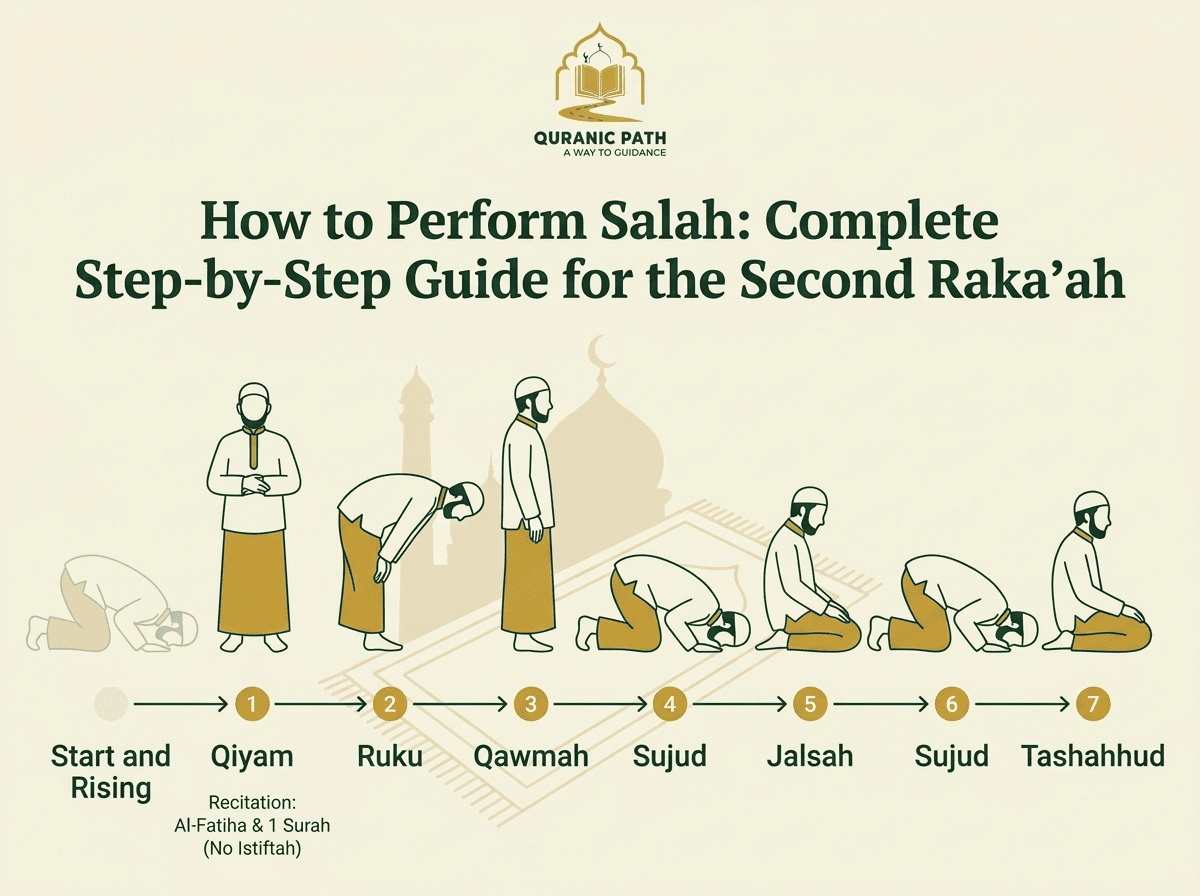
Completing the Prayer — Two, Three, and Four Rak'ah Explained
What happens after the second Raka'ah depends entirely on how many Raka'at the prayer contains. This is where Salah of 2, 3, and 4 Raka'at begin to differ from one another.
If a Person Is Praying Only Two Raka'at
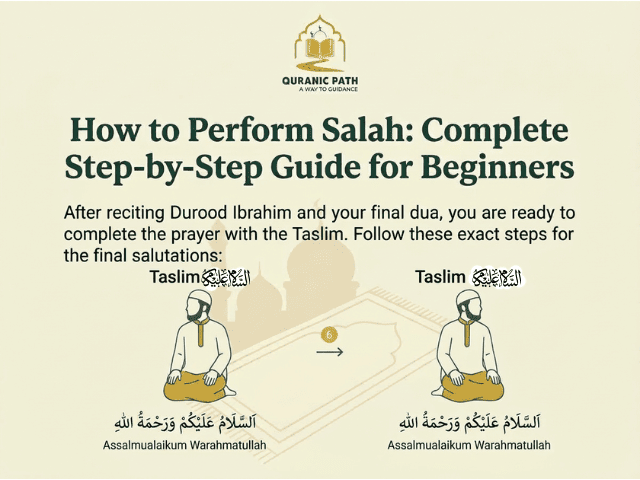
If the prayer consists of only two Raka'at (such as Fajr Fardh, or most Sunnah and Nafl prayers), the person does not stand up after the second Sajdah of the second Raka'ah. Instead, they remain seated in the Tashahhud position and recite the complete Tashahhud, followed by the complete Durood Ibrahim, closing Du'a, and then end the prayer with Salam.
Image: Tashahhud
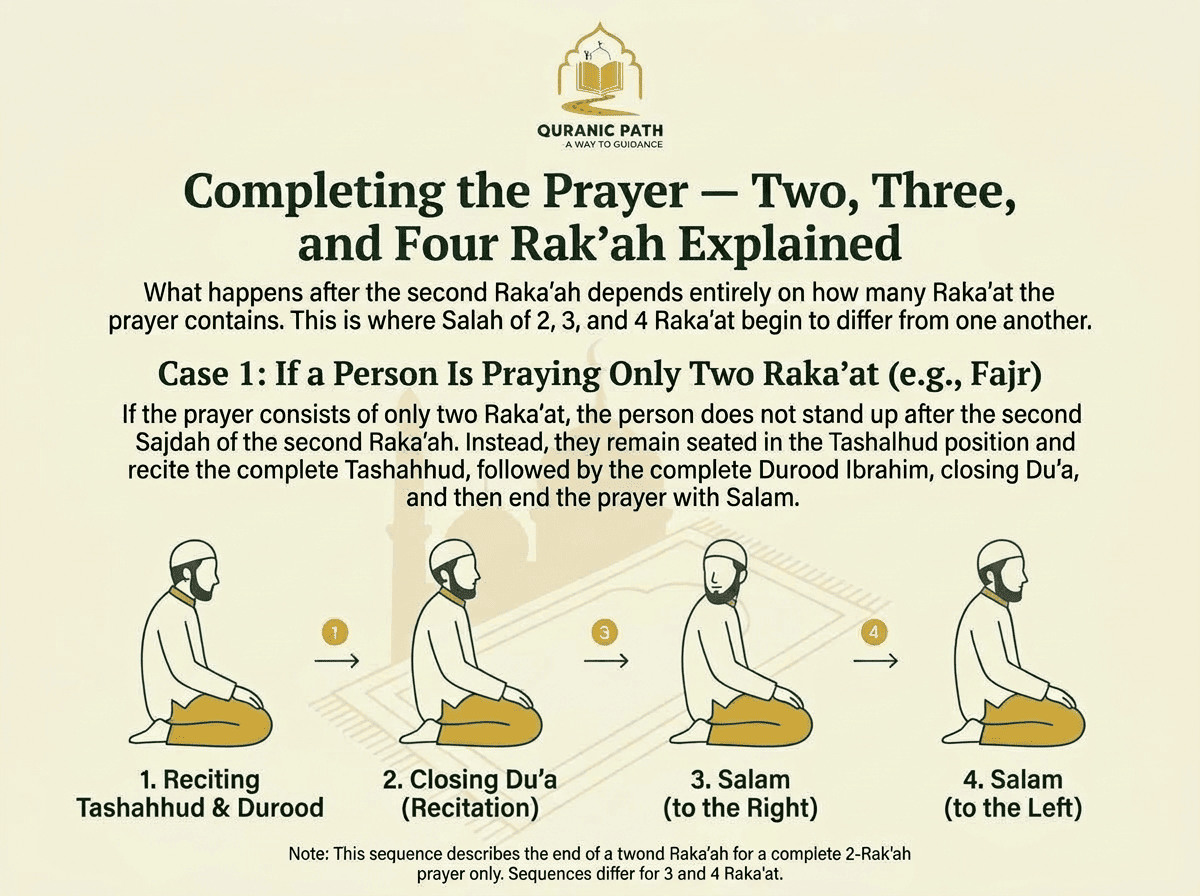
Image: Durood Ibrahim
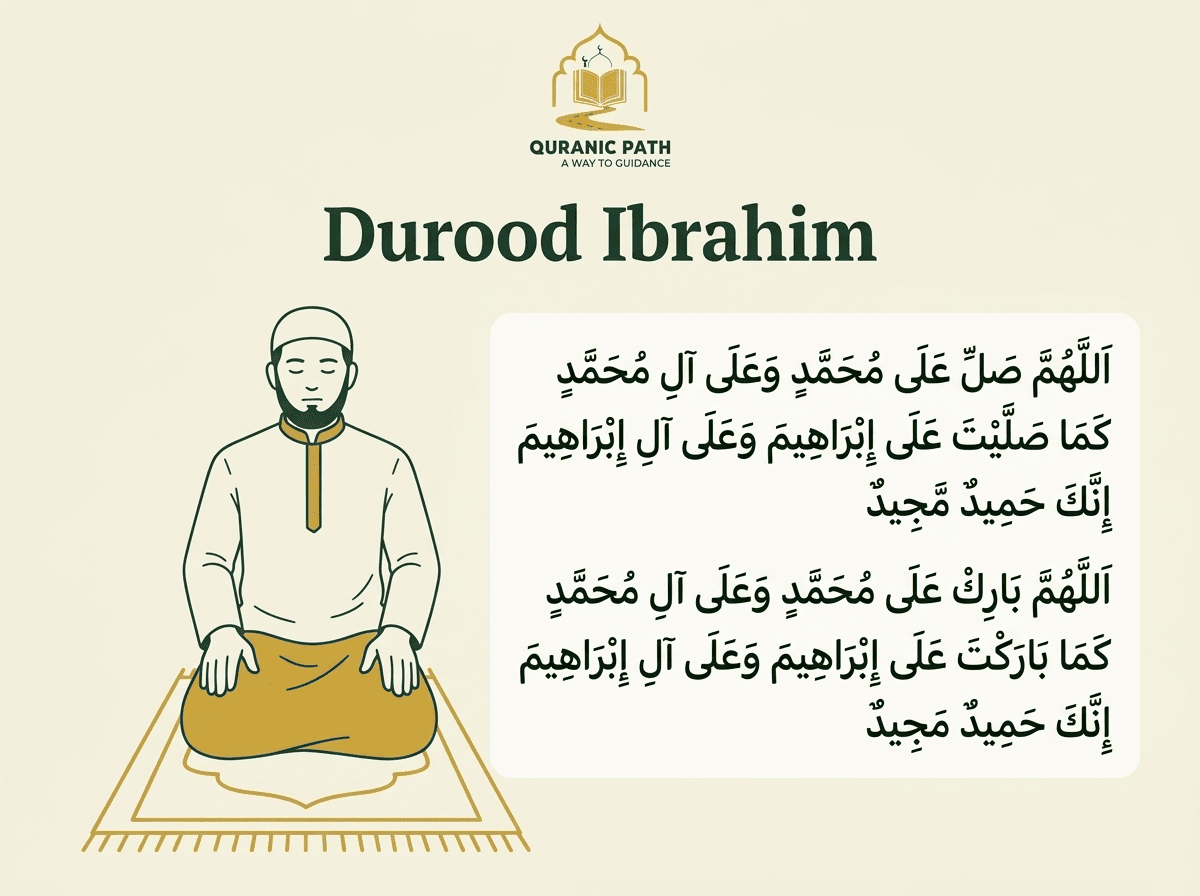
Image: Final Du'a
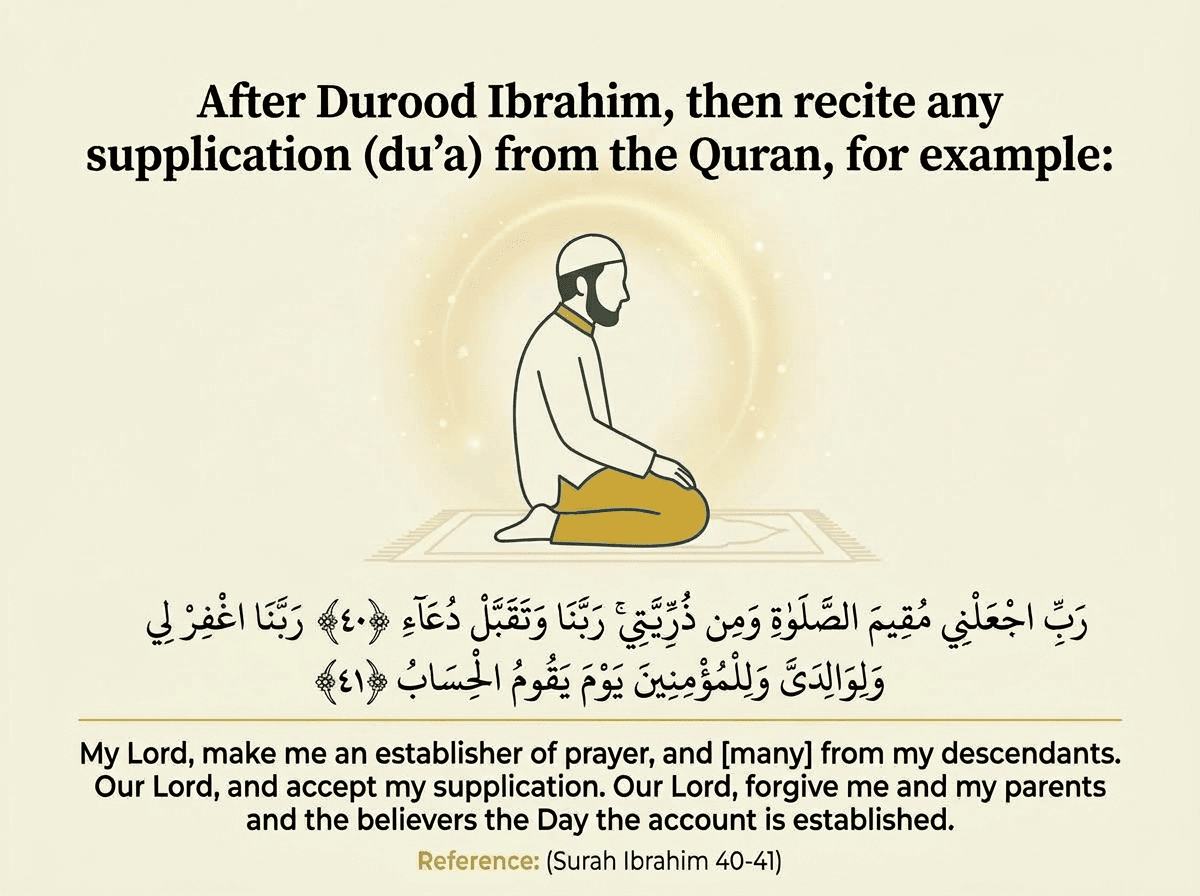
Image: Salam
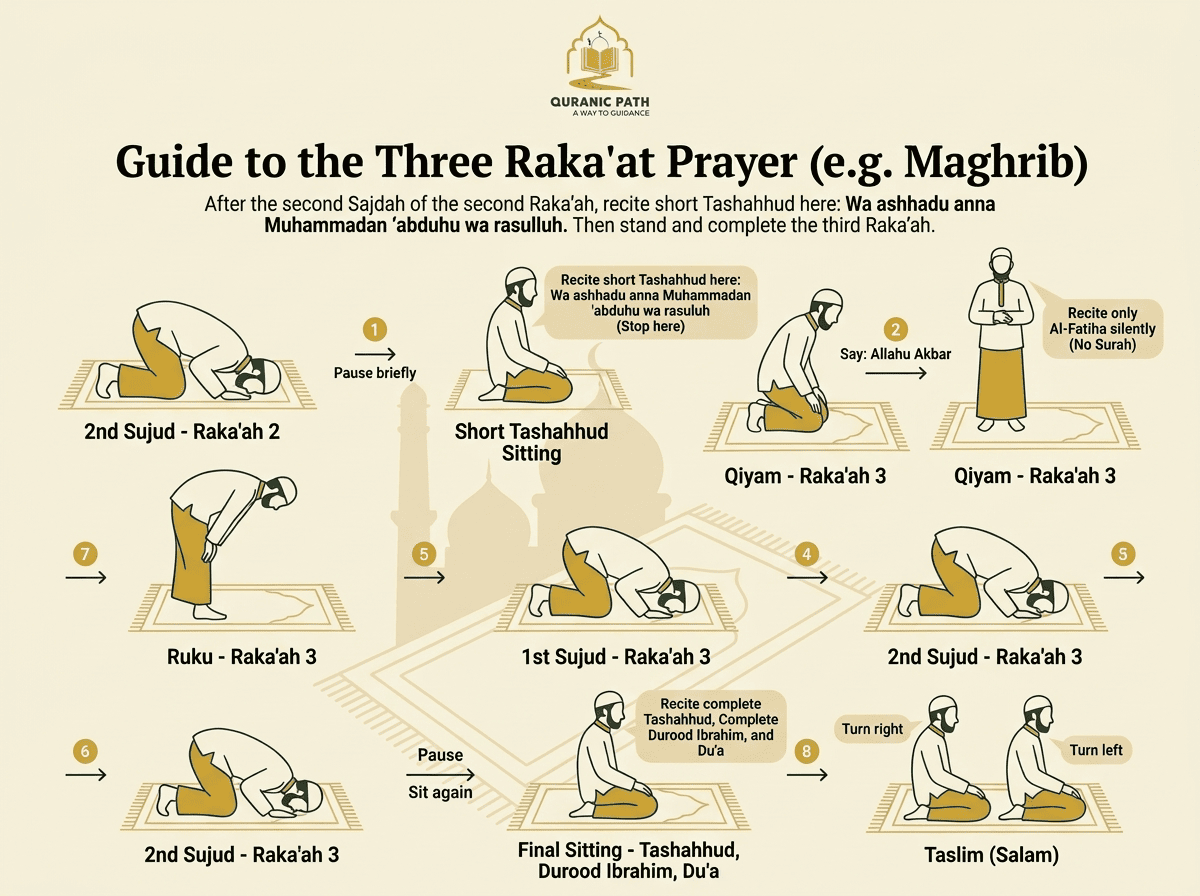
Three Raka'at (e.g. Maghrib)
In a prayer of three Raka'at, the person does stand up after the second Sajdah of the second Raka'ah — but only after pausing briefly to recite the short Tashahhud, stopping at "Wa ashhadu anna Muhammadan 'abduhu wa rasuluh" without reciting the Durood or any Du'a. They then say Allahu Akbar and stand for the third Raka'ah. In the third Raka'ah, only Al-Fatiha is recited silently (no additional Surah), followed by Ruku and the two Sajdahs as before. After the second Sajdah of this third and final Raka'ah, the person sits again — this time for the final sitting — reciting the complete Tashahhud, the complete Durood Ibrahim, Du'a, and ending with Salam.
Image: Final Sitting After the Third Rak'ah
Four Raka'at (e.g. Dhuhr, Asr, Isha)
A prayer of four Raka'at follows the same pattern as three, extended by one more unit. After the short Tashahhud following the second Raka'ah, the person stands for the third Raka'ah, reciting only Al-Fatiha (silently, with no additional Surah), then Ruku and the two Sajdahs. Without any sitting in between, they rise directly for the fourth Raka'ah, again reciting only Al-Fatiha, followed by Ruku and the two Sajdahs.
Image: Third Rak'ah
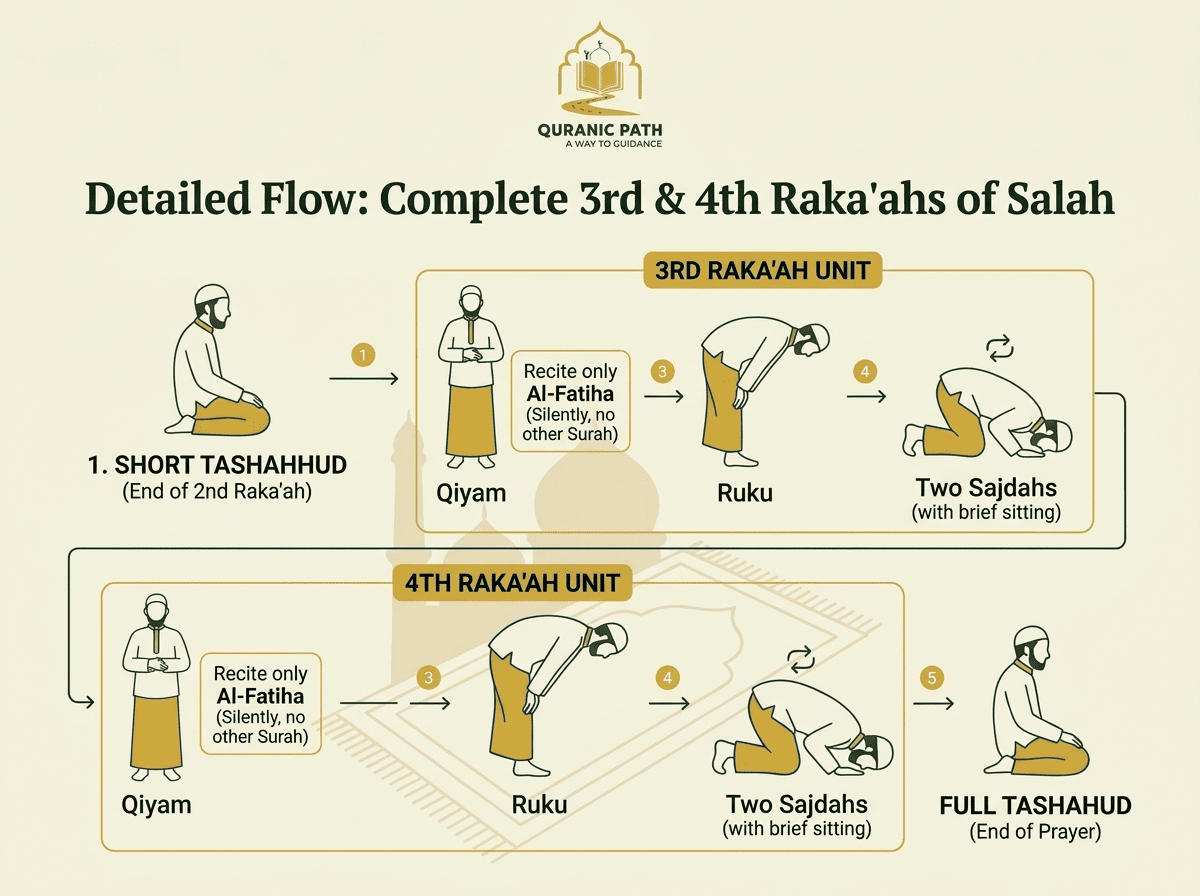
Image: Fourth Rak'ah
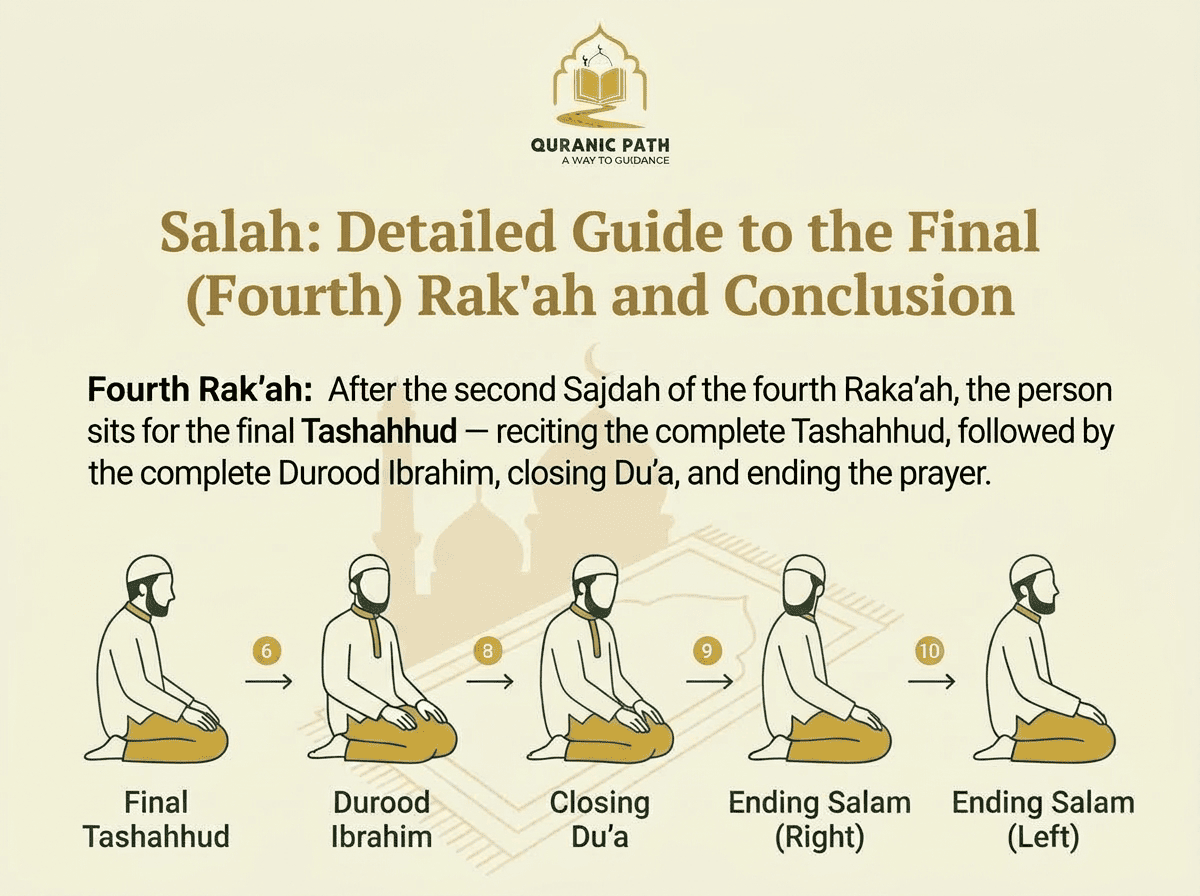
After the second Sajdah of the fourth Raka'ah, the person sits for the final Tashahhud — reciting the complete Tashahhud, followed by the complete Durood Ibrahim, closing Du'a, and ending the prayer with Salam.
Image: Final Tashahhud
Image: Durood Ibrahim
Image: Final Du'a
Image: Salam
Visual Guide to Every Salah Position
Every Raka'ah flows through six positions in exact sequence. Study each one carefully — correct posture is as important as correct recitation. Add your images at the paths shown in each card.
Stand upright facing Qibla. Right hand over left at chest. Recite Al-Fatiha + Surah.
Recite aloud in Fajr, Maghrib & Isha
Back flat at 90°. Hands grip knees, fingers spread. Head in line with spine. Recite Subhana Rabbiyal Adheem × 3.
Back must be completely horizontal
Rise fully upright. Say Sami Allahu liman hamidah then Rabbana lakal hamd. Stand briefly still.
Must stand completely straight
7 points on ground: forehead + nose, both palms, both knees, both foot-tips. Elbows raised. Recite Subhana Rabbiyal A'la × 3.
7 contact points — all must touch mat
Sit upright between the two Sujud. Hands on thighs. Say Rabbighfir li × 2. Brief calm pause.
Between 1st and 2nd Sujud only
Raise right index finger at Ashhadu. Recite full Tashahhud + Salawat. End with Tasleem right then left.
Index finger raised at AshhaduTuma'ninah — stillness is obligatory: The body must reach complete stillness in every position before moving to the next. The Prophet ﷺ told a man praying too quickly: "Go back and pray again, for you have not prayed." (Bukhari & Muslim). Slow down and be fully present in each position.
Learn to Recite Quran in Salah Correctly
The quality of your Salah depends on the quality of your Quran recitation. Our Ijazah-certified teachers will help you recite Al-Fatiha and all Quranic recitations with perfect Tajweed — making every Salah a step closer to perfection. 3 free trial classes, no card required.
Book 3 Free Trial Classes Join 300+ students from UK, USA, Canada, Australia & worldwideHow to Perform Each of the 5 Daily Prayers — Raka'at Breakdown
Now that you know how to perform one Raka'ah, here is exactly how many to perform for each prayer and where the Tashahhud sittings occur:
Fajr — The Dawn Prayer
Structure: Raka'ah 1 (standing + Ruku + 2 Sujud) → Raka'ah 2 (standing + Ruku + 2 Sujud) → Sit for Tashahhud → Tasleem.
Tashahhud: Only at the end of Raka'ah 2 (final sitting).
Recitation: Recite Al-Fatiha + additional Surah in both Raka'at.
Note: Fajr is recited aloud (Jahr). The Fajr Sunnah (2 Raka'at before) is among the most emphasised Sunnah prayers.
Dhuhr — The Midday Prayer
Structure: Raka'ah 1 → Raka'ah 2 → First Tashahhud sitting (short) → Raka'ah 3 → Raka'ah 4 → Final Tashahhud (full) → Tasleem.
First Tashahhud: Recite only up to Wa ashhadu anna Muhammadan 'abduhu wa rasuluh — then stand for Raka'ah 3.
Final Tashahhud: Recite full Tashahhud + Salawat Ibrahimiyyah + du'a.
Recitation: Dhuhr is prayed silently (Sirr).
Asr — The Afternoon Prayer
Structure: Identical to Dhuhr — 4 Raka'at with short Tashahhud after Raka'ah 2 and full Tashahhud at the end.
Recitation: Prayed silently (Sirr).
Importance: The Prophet ﷺ gave special warning about missing Asr: "Whoever misses Asr prayer, it is as if he lost his family and wealth." (Bukhari). Asr should never be delayed until after sunset.
Maghrib — The Sunset Prayer
Structure: Raka'ah 1 → Raka'ah 2 → First Tashahhud (short) → Raka'ah 3 → Final Tashahhud (full) → Tasleem.
Recitation: First 2 Raka'at recited aloud (Jahr); Raka'ah 3 recited silently.
Note: Maghrib has the shortest time window of any prayer — it should be performed as soon as possible after sunset, before twilight disappears.
Isha — The Night Prayer
Structure: Identical to Dhuhr and Asr — 4 Raka'at with short Tashahhud after Raka'ah 2 and full Tashahhud at the end.
Recitation: First 2 Raka'at recited aloud (Jahr); Raka'at 3 and 4 recited silently.
Witr: After the Isha Sunnah prayers, 3 Raka'at of Witr are performed — this is Wajib according to the Hanafi school and strongly recommended Sunnah according to others.
Common Mistakes in Salah — and How to Avoid Them
These mistakes are observed repeatedly among beginners and even long-practising Muslims. Correcting them dramatically improves the validity and quality of Salah:
Mistake 1: Rushing Through Salah Without Tranquillity (Tuma'ninah)
Tuma'ninah — remaining still for a brief moment in each position — is obligatory, not optional. Many people move so quickly through Ruku and Sujud that they never fully settle in the position. Ruku must be held until the back is flat and still. Sujud must be held until fully settled. The Prophet ﷺ told a man who prayed too quickly: "Go back and pray, for you have not prayed." (Bukhari). Slow down and be present in each position.
Mistake 2: Incorrect Recitation of Al-Fatiha
Al-Fatiha must be recited in every Raka'ah — it is a pillar of Salah. Reciting it with significant Tajweed errors, skipping words, or reciting it from memory with mistakes invalidates the Salah according to many scholars. Learning Al-Fatiha with perfect pronunciation and Tajweed is not optional — it is directly tied to the validity of every prayer you ever perform. Our Noorani Qaida guide is the starting point for correct Quran reading.
Mistake 3: Not Touching the Ground with Forehead AND Nose in Sujud
Both the forehead and the nose must touch the ground in Sujud. Many people only touch their forehead without the nose, or tilt their head so one is raised. The obligatory parts of Sujud include the nose alongside the forehead — ensure both are firmly on the ground and that you can feel pressure on both.
Mistake 4: Looking Around or Moving Excessively
The eyes should be directed toward the place of Sujud (the ground in front of you) throughout Salah. Looking around repeatedly is described in hadith as Shaytan stealing from the prayer. Excessive movement — adjusting clothing, scratching repeatedly, shifting weight frequently — also reduces the validity of Salah. If movement is necessary (adjusting the prayer mat, for example), limit it to one or two deliberate movements.
Mistake 5: Praying Fardh Prayer Without Wudu Out of Forgetfulness
If you realise during or after Salah that your Wudu was invalid, the prayer must be repeated. Always confirm you are in a state of Wudu before beginning. Establish the habit of checking before each prayer — especially if time has passed since your last Wudu or if you are uncertain whether it was invalidated.
Mistake 6: Incorrect Tashahhud — Combining Short and Full When Not Required
In 3 and 4-Raka'ah prayers, the first Tashahhud (after the second Raka'ah) must be the short version — stopping at Wa ashhadu anna Muhammadan 'abduhu wa rasuluh and standing up immediately. Reciting the full Salawat Ibrahimiyyah in the first Tashahhud (called Qa'dah Ula) and lingering there is a Sunnah-level error. Conversely, in the final Tashahhud, the Salawat must be recited in full.
Salah for New Muslims — Where to Start
For someone who has recently accepted Islam or is beginning to pray for the first time, the prospect of learning an entirely new physical practice in a foreign language can feel overwhelming. The following guidance is specifically for new Muslims and those returning to prayer after a long absence:
The Correct Approach — Learn in Stages
Do not wait until your Salah is perfect before beginning to pray. The obligation is upon you now, and Allah knows your effort and sincerity. Begin by learning the minimum required for a valid prayer and pray with what you know — then add more as you learn. Here is a suggested learning sequence:
- Week 1: Learn and memorise Al-Fatiha with correct pronunciation. Learn the Tashahhud. Learn Allahu Akbar for Takbir, the Ruku and Sujud recitations, and the Tasleem. This is the absolute minimum for valid Salah.
- Week 2: Learn the opening Du'a (Du'a Al-Istiftah). Learn one short Surah to recite after Al-Fatiha — Al-Ikhlas (Qul Huwa Allahu Ahad) is the most common choice and is 4 verses long.
- Week 3: Learn the Salawat Ibrahimiyyah for the final Tashahhud. Learn the recitations for Jalsah (sitting between Sujud).
- Ongoing: Gradually memorise more Surahs from Juz Amma to vary your recitation. Work on Tajweed to improve pronunciation. Connect with a local mosque or online Quran teacher for guidance.
Allah ﷻ knows your sincerity, your effort, and your circumstance. A new Muslim who prays with what they know — even if imperfect — is fulfilling their obligation and earning immense reward. The Prophet ﷺ said: "Actions are judged by intentions." Your intention to learn and improve is itself an act of worship. Seek knowledge, seek a teacher, and pray consistently from day one — perfection comes with practice, not before it.
Teaching Children to Pray — When and How
The Prophet Muhammad ﷺ said: "Command your children to pray when they are seven, and correct them for it when they are ten." (Abu Dawud). This hadith provides the clear Islamic framework for introducing children to Salah:
Ages 4–6: The Introduction Phase
Do not force formal prayer at this age, but introduce it naturally. Pray visibly in front of your children — let them see you pray every day. Allow them to join you on the prayer mat, imitate your movements, and ask questions. Many children at this age spontaneously begin mimicking Salah — encourage and praise this enthusiastically. Plant the seeds of love for prayer before the obligation begins.
Age 7: Begin Formal Teaching
At age 7, begin teaching children the actual prayers. Start with Fajr (2 Raka'at) as the simplest, and gradually add the other prayers. Teach Al-Fatiha with correct pronunciation — if your child is simultaneously learning to read Quran (which they should be at this age), their Salah recitation will improve in parallel. Read our guide on teaching a child to read Quran from zero for the complete Quran learning pathway alongside Salah.
Age 10: Establish the Habit
By age 10, children should be praying all five daily prayers consistently. The Prophet's ﷺ guidance to "correct them" at 10 refers to holding children accountable to regular prayer — gently but firmly. Create household prayer routines: praying together as a family, calling children to prayer at each time, and making Salah a shared family experience rather than an individual obligation.
Build Your Child's Islamic Foundation — Start with Quran
Salah requires Quran. Every Muslim who prays needs to recite Al-Fatiha correctly in every Raka'ah. Our one-to-one Quran classes give children and adults the Tajweed foundation for a lifetime of valid, beautiful Salah.
View Our Courses Or book 3 free trial classes — no card requiredFrequently Asked Questions About Salah
Salah is the Islamic ritual prayer performed five times daily. It is the second pillar of Islam and is obligatory upon every adult Muslim. The five daily prayers are Fajr (dawn), Dhuhr (midday), Asr (afternoon), Maghrib (sunset), and Isha (night). Each prayer involves specific physical positions, Arabic recitations, and a state of ritual purity (Wudu).
Salah was made obligatory during the Night Journey (Isra and Mi'raj) of the Prophet ﷺ — the only pillar of Islam delivered not through the Angel Jibreel on earth, but through direct encounter with Allah in the heavens.
The Fardh (obligatory) Raka'at: Fajr = 2, Dhuhr = 4, Asr = 4, Maghrib = 3, Isha = 4. Total: 17 Fardh Raka'at per day. Each prayer also has Sunnah Raka'at — highly recommended but not obligatory. Witr prayer (3 Raka'at after Isha) is Wajib according to the Hanafi school.
Wudu is ritual purification with water performed before Salah. The steps are: Intention → Wash hands × 3 → Rinse mouth × 3 → Rinse nose × 3 → Wash face × 3 → Wash right arm to elbow × 3 → Wash left arm × 3 → Wipe head once → Wipe ears once → Wash right foot × 3 → Wash left foot × 3.
Wudu is invalidated by: using the toilet, passing wind, deep sleep, loss of consciousness, and (according to some schools) significant bleeding.
The essential recitations are: Takbiratul Ihram (Allahu Akbar — to begin), Surah Al-Fatiha in every Raka'ah, an additional Surah in the first two Raka'at, Subhana Rabbiyal Adheem in Ruku, Sami Allahu liman hamidah / Rabbana lakal hamd when rising from Ruku, Subhana Rabbiyal A'la in Sujud, At-Tashahhud in the sitting position, Salawat Ibrahimiyyah in the final sitting, and Tasleem (As-salamu alaykum wa rahmatullah) to end.
The Qibla is the direction of the Kaaba in Mecca. From the UK: approximately southeast (~119°). From the USA East Coast: approximately northeast. From Australia: approximately northwest. From UAE/Saudi Arabia: west-northwest.
Use the Muslim Pro or Qibla Finder app on your smartphone for your precise GPS-based Qibla direction.
Salah is invalidated by: speaking intentionally, laughing aloud, losing Wudu (passing wind etc.), turning fully away from the Qibla, eating or drinking, excessive non-prayer movement, and deliberately omitting an obligatory pillar. If Salah is invalidated, it must be restarted from the beginning after renewing Wudu if necessary.
The obligatory recitations — primarily Surah Al-Fatiha and the Tashahhud — must be recited in Arabic according to scholarly consensus. Personal du'a (supplications) in Sujud and after Tashahhud can be in any language according to many scholars.
For new Muslims, learning the Arabic of Salah is a priority. Begin with Al-Fatiha and the essential phrases, and add more as your Arabic improves. Our Arabic alphabet guide is the starting point.
Fajr: True dawn until sunrise. Dhuhr: After the sun passes its zenith until shadow equals object height. Asr: From end of Dhuhr until sunset (best before sun turns yellow). Maghrib: After sunset until twilight disappears. Isha: After twilight disappears until midnight (preferred before midnight).
Prayer times vary by location and season — use Muslim Pro or Athan set to your precise location for accurate daily times.
Begin immediately by learning Salah in stages — do not wait for perfection before starting. Start with Al-Fatiha, the key Takbirs, Tashahhud, and Tasleem. Pray as much as you know and add more as you learn. Allah is aware of your effort and sincerity.
Seek a qualified teacher or attend classes at a local mosque. The obligation begins from the moment of Shahada — praying with what you know while actively learning more is the correct approach and is rewarded greatly.
Missed obligatory prayers must be made up (Qada). Perform them as you normally would, with the intention of making up the specific missed prayer. Only the Fardh Raka'at need to be made up — not the Sunnah. Make up missed prayers in order if possible.
If many prayers were missed over a long period, make up one or two per day consistently until all are completed. Never despair — the door of returning to Allah and rectifying one's worship is always open.
Conclusion — Salah is the Pillar; Everything Else Rests on It
Of all the acts of worship in Islam, Salah is the one that punctuates every single day — five times, without exception, for the entirety of a Muslim's life. It is not a burden; it is a gift. Five moments every day when the world is set aside and the servant stands directly before the Creator. Five opportunities every day for gratitude, repentance, guidance, and peace.
Learning to perform Salah correctly is a lifelong journey. The physical positions become second nature within weeks. The Arabic recitations become deeply familiar within months. The Tajweed of Al-Fatiha — recited seventeen times every single day — is worth every hour spent perfecting it. The quality of your Salah will grow as your knowledge grows, as your Arabic improves, and as your connection with the Quran deepens.
Begin today. Pray with what you know. Seek a teacher for what you do not. And trust that every sincere effort is seen and rewarded by the One you are standing before.
The Prophet ﷺ said: "The coolness of my eyes has been placed in Salah." (Nasai). May Allah make Salah the coolness of your eyes too — a source of peace, clarity, and joy in every day of your life.